Payback Period Calculator
Payback Period Calculator — A Complete Step-by-Step Guide (2026 Edition)
If you’ve ever wondered how long it will take to recover your investment, the Payback Period Calculator is one of the simplest and smartest tools you can use. Whether you’re starting a small business, buying equipment, planning a project, or comparing investment options, knowing your payback period helps you make decisions with confidence.
In this detailed guide, I’ll explain everything in a friendly, simple, and human way — with real-life examples, clear formulas, step-by-step instructions, and answers to the most common questions people ask.
The Payback Period Calculator is an essential tool for investors seeking to evaluate the time required to recoup their initial expenditures. By providing a clear and concise analysis, it facilitates informed decision-making in various financial scenarios, such as business ventures or project planning. This comprehensive guide will equip you with the necessary knowledge and techniques to effectively utilize the Payback Period Calculator, ensuring you can assess your investments with accuracy and confidence. Embrace this valuable resource to enhance your financial strategies and optimize your investment outcomes.
Let’s begin!

Table of Contents
What Is a Payback Period Calculator?
A Payback Period Calculator is a financial tool that tells you how long it takes to recover the initial investment you made in a project or asset.
In simple words:
Payback Period = Time taken to get your money back.
For example:
- You invest ₹100,000 in a small food stall.
- It earns ₹20,000 profit every month.
- You recover your investment in 5 months.
That 5 months is your payback period.
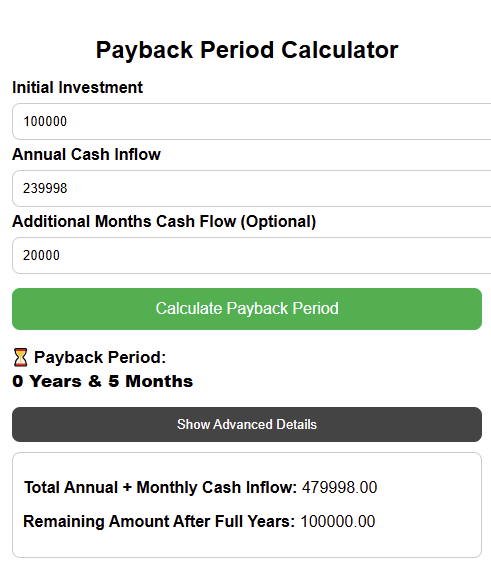
A Payback Period Calculator automates this process by calculating:
✔ Initial investment
✔ Cash inflow per month or year
✔ Total time needed to break even
✔ Cumulative return over time
You can quickly compute this using the Payback Period Calculator on your website.
Why Payback Period Is Important (With Simple Real-Life Examples)
The payback period matters because it answers one of the most important business questions:
“How long will it take to get my money back?”
Here are real-life examples showing why it’s important:
Example 1: Small Business Investment
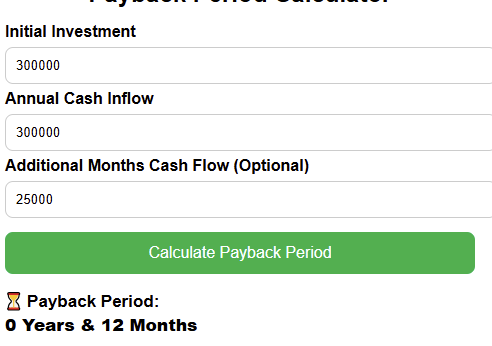
Imagine you start a mini-mart with an investment of ₹300,000.
Your average earnings per month are ₹25,000.
Payback = ₹300,000 ÷ ₹25,000 = 12 months
If the payback is too long, you might reconsider the investment.
Example 2: Buying a Machine for a Factory
A machine costs $18,000.
It saves the company $6,000 per year in labor.
Payback = $18,000 ÷ $6,000 = 3 years
If another machine gives payback in 2 years, that one might be better.
Example 3: Solar Panel Installation
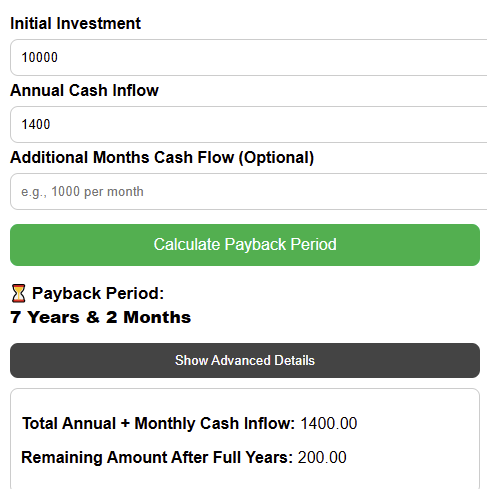
Cost of solar setup: $10,000
Electricity savings per year: $1,400
Payback = 10,000 ÷ 1,400 ≈ 7.14 years
People often ask: “What is a good payback period?”
We will cover this in Part 2.
Why It Matters Globally
Whether someone lives in India, UAE, USA, UK, Pakistan, or Africa — payback period is universal because:
- It’s easy to calculate
- It helps compare projects
- It reduces risk
- It helps in planning future savings
- It tells you how quickly you recover costs
This is why investors, students, entrepreneurs, and financial analysts use it every day.
How to Calculate Payback Period — Step-by-Step Guide
Calculating the payback period manually is simple.
There are two types of situations:
Case 1 — When Cash Inflow Is the Same Every Year
Use this method when earnings or savings are constant.
Formula:
Payback Period = Initial Investment ÷ Annual Cash InflowExample:
Investment: $20,000
Cash Inflow: $5,000 each year
Payback = 20,000 ÷ 5,000 = 4 years
Case 2 — When Cash Inflows Are Uneven
If a project earns different amounts each year, use a cumulative method.
Example:
Investment = $50,000
Yearly returns:
- Year 1: $10,000
- Year 2: $15,000
- Year 3: $20,000
- Year 4: $10,000
Cumulative:
- End of Year 1: $10,000
- End of Year 2: $25,000
- End of Year 3: $45,000
- End of Year 4: $55,000 (break-even happens here)
Payback Period = 3 + (5,000 / 10,000)
= 3.5 years
Case 3 — Monthly Payback Calculation
If monthly cash flow is known:
Payback Period (months) = Initial Investment ÷ Monthly Cash InflowExample:
Investment = ₹120,000
Monthly profit = ₹10,000
Payback = 120,000 ÷ 10,000 = 12 months
This is often used for small businesses, shops, machines, and rental income.
Payback Period Formulas Explained
Here are the most commonly used formulas and their meaning:
1. Simple Payback Period Formula
PBP = Initial Investment ÷ Annual Cash InflowBest for constant yearly returns.
2. Discounted Payback Period Formula
This method considers the time value of money.
Discounted Cash Flow = Cash Inflow / (1 + r)^nThen calculate payback using discounted values.
3. 5-Year Payback Period Formula
Frequently used for equipment and business projects:
5-Year Payback = Total 5-Year Cash Inflow – InvestmentPeople commonly ask “How to calculate payback period for 5 years?” — this formula works for that.
4. Customer Payback Period Formula
Used in marketing and subscription businesses:
Customer Payback = Customer Acquisition Cost ÷ Monthly Revenue per CustomerExample:
CAC = $40
Monthly revenue = $8
Payback = 5 months
Real-Life Examples of Payback Period (Simple & Practical)
Let’s look at some relatable examples using rupees, dollars, and business scenarios.
Example 1: Food Delivery Startup
Investment: ₹500,000
Profit per month: ₹45,000
Payback = 500,000 ÷ 45,000 ≈ 11.1 months
This is considered a very good payback for startups.
Example 2: Tech Product Launch
Investment: $120,000
Yearly earnings:
- Year 1: $20,000
- Year 2: $30,000
- Year 3: $40,000
- Year 4: $50,000
Cumulative until Year 3 = $90,000
Need = $30,000 more
Year 4 earnings = $50,000
Fraction of Year 4 = 30,000 / 50,000 = 0.6
Payback = 3.6 years
Example 3: YouTube Channel Investment
You invest in equipment: $3,000
Monthly earnings after 1 year: $300
Payback = 3,000 ÷ 300 = 10 months
Example 4: Cafe Setup
Investment: ₹800,000
Monthly net profit: ₹65,000
Payback = 800,000 ÷ 65,000 ≈ 12.3 months
Example 5: Solar System + Generator Combo
Investment: $9,000
Yearly savings: $1,200
Payback = 9,000 ÷ 1,200 = 7.5 years
Where You Can Insert Internal Links
Use sentences like:
- “You can quickly calculate this using our Payback Period Calculator on your website.”
- “To compare investments, you can also try our ROI Calculator or NPV Calculator.”
Common Mistakes People Make When Calculating Payback Period
Even though the payback period is one of the simplest financial metrics, people still make mistakes that affect their decisions. Here are the most common ones:
1. Ignoring Monthly vs Yearly Cash Flow
Some people mix monthly earnings with annual investment values.
Always use the same unit.
Example:
Investment: ₹240,000
Monthly profit: ₹20,000
If you wrongly treat it as yearly profit, your payback becomes incorrect.
2. Forgetting Tax, Fees, or Operational Costs
Actual returns may be lower due to:
- rental fees
- maintenance cost
- salaries
- electricity bill
- delivery charges
- marketing cost
These reduce your real cash inflow.
3. Assuming Cash Inflow Is Constant
Not all businesses generate the same return every year.
Seasonal businesses (ice cream shop, travel agency, event management) may have fluctuating earnings.
4. Confusing Payback Period With ROI
People often think a shorter payback period means higher profit.
But it only shows how fast you recover money, not how much you earn overall.
We will explain ROI vs Payback in detail below.
5. Not Using a Calculator for Complex Cash Flows
When inflows vary, manual calculation becomes confusing.
An online Payback Period Calculator simplifies this instantly.
Tips & Best Practices to Get Accurate Payback Estimates
Here are practical tips to help you analyze investments more professionally:
✔ Tip 1: Use Realistic Cash Inflows
Don’t assume every month will be perfect. Use expected average figures.
✔ Tip 2: Consider Hidden Costs
Include depreciation, maintenance, fuel, salaries, interest, and marketing costs.
✔ Tip 3: Combine Payback With NPV + IRR
Payback alone does not show profitability or time value of money.
That’s why businesses check:
- NPV (Net Present Value)
- IRR (Internal Rate of Return)
- ROI (Return on Investment)
You can add internal links like:
“Try our NPV Calculator or ROI Calculator for deeper analysis.”
✔ Tip 4: Compare Multiple Projects
Choose the option with the shortest payback if all other benefits are equal.
✔ Tip 5: Use a Payback Period Calculator for Accuracy
Especially for:
- uneven cash flows
- multi-year projects
- long-term investments
- discounted payback analysis
Manual calculations can easily lead to errors.
When Should You Use an Online Payback Period Calculator Instead of Doing It Manually?
You should definitely use an online calculator when:
1. The Cash Flow Is Uneven
Example:
Year 1: ₹50,000
Year 2: ₹80,000
Year 3: ₹30,000
Calculating cumulative returns manually can be time-consuming.
2. You Want Instant and Accurate Results
Businesses need quick decision-making.
An online calculator gives results in one click.
3. You’re Comparing Multiple Projects
You can easily compare:
- solar investment vs generator
- machine A vs machine B
- shop rent vs online store
- car rental vs delivery business setup
4. You’re New to Financial Calculations
Students, beginners, entrepreneurs, and small business owners benefit greatly from automatic calculators because they remove all confusion.
5. Visualization
These visuals help you understand investment performance clearly.
The Payback Period Calculator efficiently determines the duration required for an investment to be recouped through generated cash flows. By analyzing cumulative cash flows and visualizing the data, it provides a clear insight into investment recovery timelines.
People Also Ask
How to calculate a payback period?
Use the formula:
Payback = Initial Investment ÷ Annual Cash InflowIf cash inflow varies, calculate year-by-year cumulative returns until the investment amount is recovered.
How to calculate payback period for 5 years?
Add the cash inflow for 5 years and compare it with the initial investment.
If cumulative inflow reaches the investment before 5 years, note the year and calculate the remaining fraction.
How to quickly calculate payback period?
Use the simple formula:
Payback = Cost ÷ Cash Inflow
or instantly compute it using an online Payback Period Calculator.
How to calculate monthly payback?
Monthly Payback (months) = Investment ÷ Monthly ProfitHow to calculate payback period manually?
- Write the initial investment
- List yearly or monthly inflows
- Add inflows cumulatively
- Stop when the total equals the investment
- Calculate remaining fraction
How to solve payback period in Excel?
Use cumulative formulas:
- Column A: Year
- Column B: Cash flow
- Column C: Cumulative sum
Payback occurs when Column C reaches investment cost.
H3: How to calculate PBP in Excel?
Use =MATCH() and =VLOOKUP() functions to identify the year when cumulative cash inflow equals investment.
How to use IRR formula in Excel?
Use the formula:
=IRR(CashFlowRange)Example: =IRR(B2:B7).
What is the formula for payback period in ACCA?
ACCA uses:
Payback = Amount to Recover / Cash Flow in Next Yearor the standard simple formula.
What is the payback period rule?
A project is accepted if its payback period is shorter than the company’s target payback period.
What is a simple payback period?
It’s the time taken to recover the investment without considering the time value of money.
What is the difference between NPV and payback period?
- NPV measures overall profitability.
- Payback period measures how fast money is recovered.
They complement each other.
What is the difference between ROI and payback period?
- ROI shows total return.
- Payback shows time to recover investment.
You can link your ROI Calculator here.
Are ROI and EBIT the same?
No.
- ROI = Return on investment
- EBIT = Earnings before interest and taxes
What is the 10-year payback period?
It means the project takes 10 years to recover the investment.
What is an example of a payback period method?
Investment: $10,000
Inflow: $2,500 yearly
Payback = 4 years
How to calculate ROI and payback period?
- Calculate ROI using:
- Calculate payback using:
What are some examples of payback period?
- Solar panel: 7 years
- Coffee shop: 12 months
- Machine upgrade: 3.5 years
How do you interpret payback period results?
Shorter payback = lower risk + faster recovery.
What is a good payback period?
For most industries:
- Retail: Under 1 year
- Equipment: 3–5 years
- Energy/Solar: 6–8 years
- Startups: 1–3 years
What is the payback period for buying a business?
Depends on profits.
Typical: 2 to 5 years.
What are the 4 investment appraisal techniques?
- Payback period
- NPV
- IRR
- ROI
You can add internal links to all related calculators.
What is the 7% rule in investing?
Your investment doubles approximately every 10 years at 7% interest (Rule of 72).
What is the 10/5/3 rule of investment?
Typical annual returns:
- Stocks: 10%
- Bonds: 5%
- Cash: 3%
What is the meaning of IRR 12%?
Your project generates a 12% annual return, considering discounted cash flows.
Is IRR more accurate than payback period?
IRR is more detailed because it includes time value of money.
Payback is simpler and quicker.
Which is better: NPV, IRR or payback?
Use all three together for best analysis:
- Payback = speed
- NPV = value
- IRR = rate of return
What is the formula for calculating CAC?
CAC = Total Marketing Cost ÷ Number of New CustomersWhat is a good 10-year return on investment?
Generally 7–12% annually.
What is the rule of 70 in investing?
It estimates how quickly something doubles:
70 ÷ growth rate.
How to calculate period in Excel?
Use:
=NPER(rate, payment, present_value)How to calculate 5-year total return?
Total Return = (Final Value – Initial Value) ÷ Initial ValueWhat is 12% compounded monthly?
Equivalent annual yield =
(1 + 0.12/12)^12 – 1≈ 12.68%
What does a 70% ROI mean?
You earned 70% more than your initial investment.
What is a 7% annual return?
Your money grows by 7% per year.
Example: ₹100,000 → ₹107,000 after 1 year.
What is NPV of 10,000 at 7%?
NPV = Cash Flow / (1 + 0.07)^nHow to calculate NPV, IRR, and payback period?
You can compute all three using Excel or online calculators.
Add internal links to:
- NPV Calculator
- IRR Calculator
- Payback Period Calculator
FAQs
What is a payback period used for?
To find how long it takes to recover investment cost.
Is a shorter payback better?
Yes. Faster recovery = lower risk.
Does payback include interest?
Simple payback does not. Discounted payback does.
Is payback period the same as ROI?
No. Payback shows time; ROI shows total return.
Can payback period be negative?
No. You can only have longer or shorter payback.
What is a reasonable payback period?
1–5 years depending on industry.
Is payback period useful for startups?
Yes, especially to measure how quickly costs are recovered.
What is discounted payback?
A method that uses discounted cash flows for more accuracy.
Is payback better monthly or yearly?
Depends on the business. Retail and services use monthly; manufacturing uses yearly.
Why is payback period important?
It helps with budgeting, planning, and comparing investment options.
What happens after payback is achieved?
You start earning pure profit.
Which calculator should I use?
Use a Payback Period Calculator for fast and accurate results.
Use Our Other Calculators
“Use our Payback Period Calculator to compute this instantly.”
“You can also try our ROI Calculator to compare profitability.”
“Use the Discount Calculator when analyzing cost savings.”
Final Thoughts
The payback period is one of the most beginner-friendly and practical financial tools. Whether you are an entrepreneur, student, investor, or business owner, knowing how fast you recover your investment gives you confidence and clarity.
Using a Payback Period Calculator saves time, avoids manual errors, and helps you compare projects instantly. Always combine payback with ROI, NPV, and IRR to make smart, informed financial decisions.
This detailed guide should help you master the concept completely — with formulas, examples, tips, Excel tricks, and all major questions answered.
Thank you for reading this post, don't forget to subscribe!