Lumber Volume Calculator
Calculatorsera.com
Your Perfect Project Awaits: Master Wood Measurements with the Lumber Volume Calculator
Lumber Volume Calculator Have you ever started a woodworking project, like building a bookshelf or a treehouse, only to realize you didn’t buy enough wood? Or maybe you bought way too much and had a big, expensive pile of leftover lumber? If this sounds familiar, you’re not alone. Figuring out exactly how much wood you need can be one of the trickiest parts of any project.
But what if you had a helper that could do all the tricky math for you in seconds? That’s exactly what a Lumber Volume Calculator does. This simple online tool takes the guesswork out of wood shopping. It helps you figure out the exact amount of wood you need, so you can save money, avoid waste, and make your project run smoothly. Whether you’re a professional carpenter, a construction planner, or a weekend DIYer, this calculator is your new best friend.
Let’s dive in and learn how this handy tool can make your next project a total success.
Table of Contents
What is a Lumber Volume Calculator?
Imagine you have a cardboard box. To know how much stuff can fit inside, you need to know its volume. You’d measure its length, width, and height and multiply them together. A Lumber Volume Calculator does the same thing for wood.
In simple terms, a Lumber Volume Calculator is a digital tool that figures out the total space a piece of lumber occupies. You just type in the wood’s dimensions—its length, width, and thickness—and the calculator instantly tells you the volume.
This is super useful because wood is often priced and sold by its volume, not just by the piece. The calculator can give you the answer in different units that people use for wood, such as:
- Board Feet (BF): The most common way to measure lumber in the United States and Canada.
- Cubic Meters (m³): Often used in international trade and large construction projects.
- Cubic Feet or Inches: Great for smaller projects or when you need a very precise measurement.
For example, if you have a plank that is 2 inches thick, 6 inches wide, and 8 feet long, the calculator can tell you its volume in board feet in the blink of an eye. No more head-scratching or complicated math!

Why is Lumber Volume Important?
You might be wondering, “Why can’t I just count the number of boards?” Knowing the total volume of lumber is like knowing the total ingredients for a recipe. Counting boards is like counting eggs, but if you need flour and sugar too, you need to know the amounts.
Here’s why knowing the volume is a game-changer:
- Saves You Money: Buying too much wood is a waste of money. Buying too little means extra trips to the lumberyard and potentially paying more for small quantities. Accurate volume calculation helps you buy the perfect amount.
- Prevents Waste: When you buy the right amount, you have less leftover scrap. This is not only good for your wallet but also better for the environment.
- Ensures Accuracy in Projects: In construction and furniture making, being off by even a small amount can cause big problems. Knowing your total lumber volume helps you plan better and build things that are strong, stable, and look professional.
- Helps with Budgeting: If you know the volume of wood you need, you can get accurate price quotes from suppliers, since many of them price wood by the board foot or cubic meter.
Think of it this way: If you’re building a picnic table and you need 10 planks, knowing the total volume helps you understand the true cost and amount of material, ensuring you don’t run out halfway through.
How Does a Lumber Volume Calculator Work?
The magic behind the Lumber Volume Calculator is actually a very simple math formula. It’s built into the tool, so you don’t have to worry about doing the calculations yourself!
Here’s the basic idea:
The Inputs (What You Tell the Calculator):
- Length: How long is the piece of wood?
- Width: How wide is it?
- Thickness: How thick is it?
- Quantity: How many identical pieces do you have?
The Output (What the Calculator Tells You):
- The Total Volume of all your wood in the unit you choose (like board feet or cubic meters).
The Simple Formula:
The calculator uses this basic rule: Volume = Length × Width × Thickness.
It’s that straightforward! The calculator is smart enough to handle different units. So, if you measure length in feet and width in inches, it can automatically convert everything and give you a correct answer. This makes it incredibly flexible and easy to use.
Step-by-Step: How to Use the Lumber Volume Calculator
Using the calculator is as easy as 1-2-3. Let’s walk through it together.
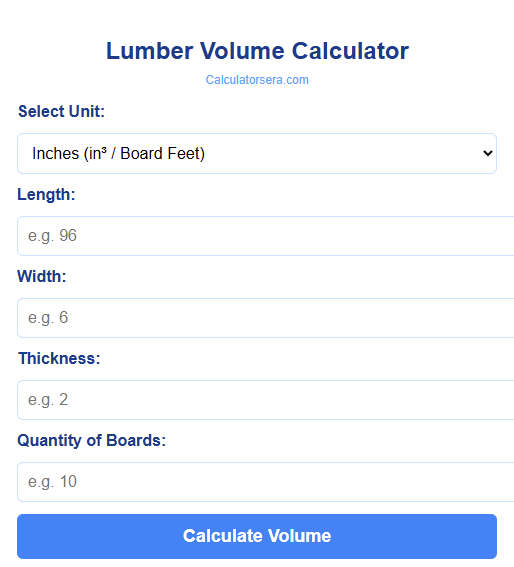
- Enter the Length: Find your tape measure and measure the length of your lumber. Type this number into the “Length” box. Remember to select the correct unit (e.g., inches, feet, meters) from the dropdown menu.
- Enter the Width: Next, measure the width of the lumber. Type this number into the “Width” box and select its unit.
- Enter the Thickness: Now, measure the thickness. Enter this value and its unit in the “Thickness” box.
- Choose Your Output Unit: Before calculating, select how you want the answer. Do you need it in Board Feet? Cubic Meters? Choose from the list.
- Enter the Quantity (Optional): If you have more than one piece of wood that is exactly the same size, type the number of pieces in the “Quantity” box. This will calculate the total volume for all of them at once.
- Click Calculate: Hit the “Calculate” button! The tool will instantly show you the total volume of your lumber.
That’s it! In just six simple steps, you’ve done what would normally require a calculator, a notepad, and a lot of time.
Example: Calculating Lumber Volume
Let’s make this real with an example. Imagine you are building a bench and you need 10 identical wooden planks. Each plank is:
- Thickness: 2 inches
- Width: 8 inches
- Length: 10 feet
Instead of doing complicated math, you open the Lumber Volume Calculator on CalculatorSera.com.
- You enter
10for Length and selectfeet. - You enter
8for Width and selectinches. - You enter
2for Thickness and selectinches. - You select
Board Feetas your output unit. - You enter
10in the Quantity field. - You click Calculate.
The calculator instantly tells you that the total volume you need is 133.33 Board Feet. Now you can go to the lumberyard and confidently order exactly 133 board feet of lumber in the right dimensions, knowing it will be perfect for your project.
Chart Visualization: Lumber Volume Breakdown
Sometimes, seeing your results in a chart can make it even easier to understand, especially if you’re working with different units or comparing options. Our Lumber Volume Calculator can display your results in a simple bar chart.
This visual breakdown helps you quickly see how the volume looks in different units. For instance, the same pile of wood might be 133 Board Feet, but it’s also 1.75 Cubic Meters. This is super helpful for international projects where you might need to communicate with people who use different measurement systems.
Lumber Volume Breakdown Visualization
Visual representation of the same wood volume across different measurement units
Common Lumber Measurement Units
When you use the calculator, you’ll see a few different units. Let’s break down what they mean in simple language.
Board Feet (BF)
This is the star of the show in North America. A board foot is a specific volume of wood.
- Definition: 1 board foot is a piece of wood that is 1 inch thick, 12 inches wide, and 12 inches long (or any combination of measurements that equals 144 cubic inches).
- Simple Example: A plank that is 1 inch thick, 6 inches wide, and 24 inches long is exactly 1 board foot. (1 in x 6 in x 24 in = 144 cubic inches).
Cubic Meters (m³)
This is the standard unit of volume in the metric system, used all over the world for big shipments of wood.
- Definition: It’s the volume of a cube that is 1 meter long, 1 meter wide, and 1 meter tall.
- Simple Example: A large beam that is 0.1 meters thick, 0.2 meters wide, and 5 meters long has a volume of 0.1 cubic meters. (0.1 x 0.2 x 5 = 0.1 m³).
Cubic Feet (cu ft) or Cubic Inches (cu in)
These are great for smaller, more precise projects, especially in the US.
- Definition: A cubic foot is the volume of a cube with 1-foot sides. A cubic inch is a cube with 1-inch sides.
- Simple Example: A small block of wood for a carving project that is 3 inches long, 3 inches wide, and 3 inches tall has a volume of 27 cubic inches.
Real-Life Uses of Lumber Volume Calculator
This tool isn’t just for math practice; it’s used every day by all kinds of people who work with wood.
- Carpentry Projects: A furniture maker uses it to estimate how much oak is needed for a new dining room table, ensuring they don’t overspend on expensive hardwood.
- Construction Sites: A foreman uses it to calculate the total volume of 2x4s and plywood needed to frame a house, helping to order materials in bulk and stay on budget.
- Sawmills and Lumberyards: Workers use it to price logs and cut lumber accurately for their customers. They need to know the volume to set a fair price.
- DIY Projects: A homeowner building a garden planter box uses it to figure out how much pine to buy for a weekend project, avoiding wasted trips and materials.
Benefits of Using an Online Lumber Volume Calculator
Why should you use an online calculator instead of doing it by hand? Here are the top reasons:
- Accuracy: It eliminates human error. No more misplaced decimals or wrong unit conversions.
- Speed: Get your answer in seconds, not minutes. This frees up your time to focus on the fun part—building!
- Prevents Waste: By ordering the perfect amount of wood, you reduce scrap and save natural resources.
- Extremely Easy to Use: The simple interface is friendly for everyone, from seasoned pros to first-time DIYers.
- Works with Multiple Units: It seamlessly converts between imperial and metric units, which is perfect for modern, global projects.
- Helpful for Cost Planning: By knowing the exact volume, you can calculate material costs with much greater precision.
Lumber Volume Formula (Simplified)
For those who are curious, here’s a peek at the simple math happening behind the screen. Don’t worry, the calculator still does all the work for you!
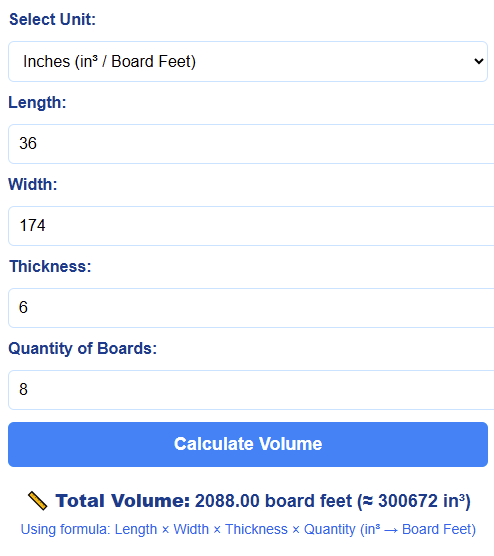
The Basic Formula:Volume = Length × Width × Thickness
But the calculator adjusts this formula slightly depending on the units you want. Here’s how it works for the most common units:
For Board Feet:
The formula is: (Thickness (in) × Width (in) × Length (ft)) / 12
Let’s use our example from before: (2 inches x 8 inches x 10 feet) / 12 = 160 / 12 = 13.33 board feet per plank. We had 10 planks, so 13.33 x 10 = 133.33 Board Feet.
For Cubic Feet:
First, make sure all measurements are in feet.Volume = Length (ft) × Width (ft) × Thickness (ft)
In our example: Thickness= 2/12 = 0.167 ft, Width= 8/12= 0.667 ft, Length= 10 ft.
So, 0.167 ft × 0.667 ft × 10 ft = 1.11 Cubic Feet per plank. For 10 planks, that’s 11.1 cubic feet.
Converting to Cubic Meters:
Since 1 cubic meter ≈ 35.315 cubic feet, you just divide.11.1 cubic feet / 35.315 = **0.314 Cubic Meters** for our 10 planks.
Tips for Accurate Measurement
To get the best results from the calculator, follow these easy tips:
- Be Consistent with Units: Try to measure everything in the same unit system (all inches or all feet) to make it simpler, but the calculator can handle the conversion if you mix them.
- Round Up for Safety: When you get your final volume, it’s a good idea to round up to the nearest whole number. This gives you a little extra wood for mistakes, cutting, and trimming.
- Double-Check Your Numbers: Before you hit “calculate,” take one more look at your measurements and the quantity. A small typo can lead to a big difference!
- Account for Wood Movement: Remember that wood can expand or contract slightly with changes in humidity. For very precise projects, this is something to keep in mind, but for most uses, the calculator’s result is perfect.
FAQs For Lumber Volume Calculator
What is the lumber volume calculator used for?
It’s used to find the total amount of space a piece of lumber takes up. This helps you know how much wood to buy for projects, how much it will cost, and helps prevent waste.
Can I calculate log volume with it?
Most standard lumber calculators are designed for cut, rectangular boards. Logs are round and irregular, so they need a special Log Volume Calculator that uses different formulas.
What is a board foot?
A board foot is a special unit for lumber. It represents a piece of wood that is 1 inch thick, 12 inches wide, and 12 inches long.
Does it work for irregular shapes?
No, the standard calculator is for boards with straight, even sides. For irregular shapes like live-edge slabs, you might need to approximate its dimensions or use a different tool.
Can I use it for international projects?
Absolutely! Yes. Because it can calculate volume in cubic meters (the international standard) and convert from imperial units, it’s perfect for projects anywhere in the world.
Is the calculator free to use?
Yes! The Lumber Volume Calculator on CalculatorSera.com is completely free and requires no sign-up.
Conclusion
A Lumber Volume Calculator is more than just a handy tool—it’s a smart way to plan any project that involves wood. It takes the confusion and stress out of measuring, saves you time and money, and helps you become a more efficient builder, whether you’re crafting a small birdhouse or framing an entire building.
By understanding how much wood you truly need, you can walk into any lumberyard with confidence and focus on the joy of creating something with your own hands.
Next time you plan a woodworking project, skip the complicated math and use the Lumber Volume Calculator on CalculatorSera.com to get the right measurements instantly
Thank you for reading this post, don't forget to subscribe!