Cylinder Volume Calculator
Calculatorsera.com
Calculate the volume of a cylinder using radius or diameter and height.
Formula: π × r² × h
Introduction Cylinder Volume Calculator
Have you ever wondered how much water fits inside a can, pipe, or tank? That’s what a cylinder volume calculator helps you find!
Think about a soda can. It’s tall and round. Or picture a water tank. It’s big and holds a lot of water. These are cylinders. A cylinder is a simple 3D shape. It has a circular top and bottom. And it has a curved side.
Figuring out how much space is inside a cylinder can be tricky. But it doesn’t have to be. Our Cylinder Volume Calculator makes it super easy. You just type in two numbers. And the calculator does the rest. It’s perfect for students, teachers, builders, and anyone who is curious.
In this blog post, we will learn all about cylinders. We will learn what volume is. We will learn the formula for cylinder volume. And we will see how our calculator works. We will also look at fun, real-life examples. Let’s get started!
Table of Contents
What Is a Cylinder?
A cylinder is a 3D shape. It looks like a can or a tube. It has two main parts.
First, it has two circular bases. One is at the top. One is at the bottom. These circles are the same size. They are flat and parallel to each other.
Second, it has a curved surface that connects the two bases. If you roll up a piece of paper, you get a cylinder.
Here are some key parts of a cylinder:
- Radius (r): This is the distance from the center of the circle to its edge. It’s half of the circle’s width.
- Diameter (d): This is the distance across the circle, passing through the center. It is twice the radius (d = 2 × r).
- Height (h): This is the distance from the top base to the bottom base. It’s how tall the cylinder is.
Think of a soup can. The round part on the top is the base. The distance from the center of that lid to the edge is the radius. The height of the can is how tall it is.

What Is Cylinder Volume?
Volume is how much space something takes up inside. For a cylinder, volume tells us how much stuff can fit inside it.
Imagine you have a water bottle. If you fill it to the top with water, the amount of water inside is its volume. If you have a bigger bottle, it can hold more water. That means it has a larger volume.
Volume is measured in cubic units. Some common units are:
- Cubic centimeters (cm³)
- Cubic meters (m³)
- Cubic inches (in³)
- Liters (L) – often used for liquids
So, when we calculate the volume of a cylinder, we are finding the number of little cubes that can fit inside it.
Cylinder Volume Formula
To find the volume of a cylinder, we use a special formula. Don’t worry, it’s not as hard as it looks!
The formula is:
Volume = π × r² × h
Let’s break that down:
- π (Pi): This is a special number in math. It is about 3.14159. For most calculations, we can use 3.14. Our calculator uses a more precise value.
- r (Radius): This is the radius of the circular base.
- h (Height): This is the height of the cylinder.
So, in simple words, the formula is: Pi times radius squared times height.
What does “radius squared” mean? It just means you multiply the radius by itself (r × r).
Cylinder Volume Calculator Let’s see why this formula works. First, we find the area of the circular base. The area of a circle is π × r². This tells us how much space the circle covers. Then, we multiply that area by the height (h). This stacks the circle’s area all the way up to the top. That gives us the total volume!
How the Cylinder Volume Calculator Works
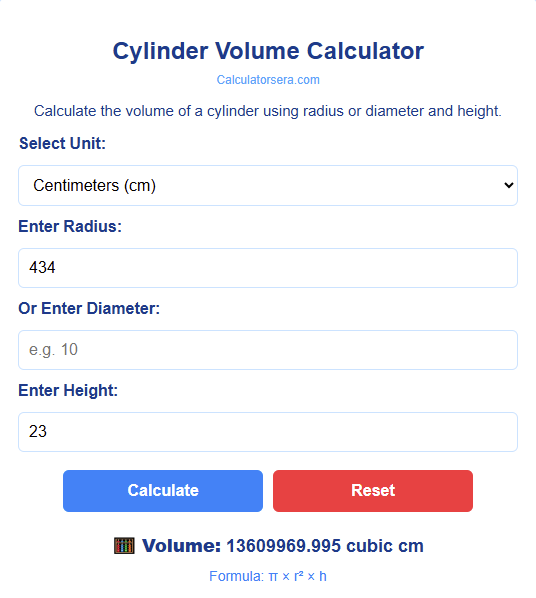
Our Cylinder Volume Calculator is very easy to use. It does the math for you instantly. Here’s how you can use it in just four steps:
Step 1: Enter the radius.
Type the radius of your cylinder into the first box. Remember, the radius is half the width of the circle.
Step 2: Enter the height.
Type the height of your cylinder into the second box.
Step 3: Click Calculate.
Press the “Calculate” button. That’s it!
Step 4: Get the volume instantly.
The calculator will show you the volume in cubic units. If you entered the radius and height in centimeters, the answer will be in cm³. If you used inches, it will be in in³.
Our calculator is smart. It can work with both metric units (like cm, m) and imperial units (like inches, feet). You don’t need to worry about converting anything. Just type your numbers, and you’ll get the right answer.
Example Calculations
Cylinder Volume Calculator Let’s try some examples to see how it works.
Example 1: A Water Glass
Cylinder Volume Calculator Imagine you have a cylindrical water glass. The radius of the base is 5 cm. The height of the glass is 10 cm. What is its volume?
We use the formula: Volume = π × r² × h
- First, square the radius: r² = 5 × 5 = 25
- Then, multiply by pi: π × 25 ≈ 3.1416 × 25 = 78.54
- Finally, multiply by the height: 78.54 × 10 = 785.4
So, the volume of the glass is 785.4 cubic centimeters (cm³). That’s how much water it can hold!
Example 2: A Short Pipe
Cylinder Volume Calculator Now, let’s say you have a small pipe. The radius is 3 inches. The height is 7 inches. What is its volume?
Volume = π × r² × h
- Square the radius: r² = 3 × 3 = 9
- Multiply by pi: π × 9 ≈ 3.1416 × 9 = 28.2744
- Multiply by the height: 28.2744 × 7 = 197.92
So, the volume of the pipe is about 197.9 cubic inches (in³).
Real-Life Uses of Cylinder Volume
You might be surprised how often cylinder volume is used in everyday life! Here are some fun examples:
- Water Tanks: Many homes have cylindrical water tanks. Knowing the volume helps us figure out how much water they can store for drinking, bathing, and cleaning.
- Pipes: Plumbers need to know the volume of pipes. This helps them understand how much water can flow through them.
- Cans & Bottles: Soda cans, soup cans, and water bottles are often cylinders. Companies use volume to decide how much liquid to put inside.
- Construction: Builders use cylinder volume when working with concrete pillars. They need to know how much concrete to mix to fill the cylindrical molds.
- Science Experiments: In a lab, scientists use graduated cylinders to measure liquids. They need to understand volume to get their experiments right.
- Cooking: Some baking pans are cylindrical. Knowing the volume can help you know how much batter you need.
Understanding Units
The unit you use for your answer is very important. It depends on the units you used for the radius and height.
- If you measure in centimeters (cm), the volume will be in cubic centimeters (cm³).
- If you measure in meters (m), the volume will be in cubic meters (m³).
- If you measure in inches (in), the volume will be in cubic inches (in³).
- If you measure in feet (ft), the volume will be in cubic feet (ft³).
Sometimes, we need to convert between units. Here are some helpful tips:
- For liquids, we often use liters. 1000 cm³ is equal to 1 liter. So, our water glass from the example that held 785.4 cm³ can hold about 0.785 liters of water.
- For larger volumes, like a water tank, we might use cubic meters. 1 m³ is equal to 1000 liters.
Visualizing Cylinder Volume
Sometimes it helps to see things. Let’s try to visualize the volume of a cylinder.
Imagine our water glass from Example 1. Its volume was 785.4 cm³. Think of little sugar cubes that are 1 cm on each side. Each cube has a volume of 1 cm³. To fill our glass, we would need 785 of these little cubes! That’s a lot of sugar cubes.
The chart below helps you see how the different parts of the cylinder relate to each other. It shows the radius, the height, and the final volume we calculated.
Cylinder Volume Calculator This chart shows the radius and height of our glass. You can see that the volume is much bigger. This is because the volume depends on both the radius and the height. If you change the radius just a little, the volume changes a lot!
How to Use Calculatorsera’s Cylinder Volume Calculator
Cylinder Volume Calculator Using our calculator is a breeze. It’s designed to be simple for everyone.
- Go to the Calculator: On our website, Calculatorsera.com, find the Cylinder Volume Calculator.
- Input Your Numbers: You will see two clear boxes. One is for the radius. One is for the height. Type your numbers in these boxes.
- Choose Your Units (if available): Some calculators let you pick units. You might see a dropdown menu to choose cm, m, inches, etc. Make sure the units for radius and height are the same!
- Click the Button: Press the “Calculate” button.
- Read Your Result: Your answer will appear on the screen. It will be the volume of your cylinder.
Our calculator is also responsive. This means it works perfectly on your phone, tablet, or computer. You can use it at school, at work, or at home.
Benefits of Using an Online Calculator
Cylinder Volume Calculator Why should you use an online calculator like ours? Here are some great reasons:
- Saves Time: You get the answer in less than a second. No need for paper, pencil, or a long time spent calculating.
- No Math Mistakes: It’s easy to make a mistake when you do math by hand. The calculator never makes a mistake. You can trust the answer.
- Great for Everyone: Students can check their homework. Teachers can create examples. Builders and engineers can do quick checks on their projects.
- Easy Unit Conversion: You don’t have to worry about converting units yourself. The calculator handles it for you.
Common Mistakes to Avoid
Cylinder Volume Calculator When people calculate cylinder volume by hand, they sometimes make small errors. Here’s what to watch out for:
- Mixing up radius and diameter: This is the most common mistake! Remember, the formula uses the radius, not the diameter. If you are given the diameter, divide it by 2 first to get the radius.
- Forgetting to square the radius: The formula is r², not r × 2. Don’t just double the radius; multiply it by itself.
- Using different units: If the radius is in centimeters and the height is in meters, you must convert them to the same unit before calculating. Otherwise, the answer will be wrong.
- Ignoring unit conversion for the answer: Remember, if you put in centimeters, the volume is in cm³. Don’t call it liters or gallons without converting.
Cylinder Volume in Real Projects
Cylinder Volume Calculator Let’s see how different people use cylinder volume in their jobs and hobbies.
- Plumbing: A plumber needs to know the volume of a pipe to figure out the water flow capacity. This helps in designing the plumbing for a house.
- Construction: When building a round concrete pillar, workers need to know its volume. This tells them how much concrete to order. Ordering too much is wasteful. Ordering too little delays the project.
- Science: A chemist uses a graduated cylinder to measure liquids for experiments. They need to understand volume to mix chemicals correctly.
- Manufacturing: A company that makes soda needs to know the volume of their cans. This ensures every can has the same amount of drink.
- Gardening: If you have a cylindrical rain barrel, knowing its volume helps you know how much rainwater you’ve collected for your plants.
Comparison Table
A cylinder is not the only 3D shape! Here is a quick comparison of volume formulas for different shapes.
| Shape | Formula | Example (using r=3 cm, h=10 cm or side=5 cm) | Example Volume |
|---|---|---|---|
| Cube | side³ | side = 5 cm | 5³ = 125 cm³ |
| Sphere | (4/3)πr³ | r = 3 cm | (4/3) × 3.14 × 27 ≈ 113.1 cm³ |
| Cylinder | πr²h | r = 5 cm, h = 10 cm | 3.14 × 25 × 10 = 785 cm³ |
As you can see, for the same “size” of numbers, a cylinder can hold much more than a cube or a sphere! This is why cylinders are so popular for storing things.
Fun Facts About Cylinders
Cylinder Volume Calculator
- The Great Pyramid of Giza in Egypt was built with cylinders! Workers used wooden rollers (cylinders) to move the heavy stone blocks.
- Soda cans are engineered to be nearly perfect cylinders. This makes them strong and easy to stack and store.
- The cylinder is one of the most basic and strongest 3D shapes in geometry.
- The word “cylinder” comes from the Greek word “kylindros,” which means “roller.”
FAQs Cylinder Volume Calculator
What is the volume of a cylinder?
The volume of a cylinder is the amount of space inside it. It is calculated using the formula π × r² × h, where ‘r’ is the radius of the base and ‘h’ is the height.
How do I find volume using diameter instead of radius?
The formula uses radius. If you have the diameter, just divide it by 2 to get the radius. Then, plug the radius into the formula. For example, if the diameter is 10 cm, the radius is 5 cm.
What units are used for cylinder volume?
Volume is always in cubic units. Common units are cubic centimeters (cm³), cubic meters (m³), and cubic inches (in³). For liquids, it is often converted to liters or gallons.
Can I calculate cylinder volume online?
Yes! You can use our free Cylinder Volume Calculator on Calculatorsera.com. It’s fast, accurate, and easy to use.
What if I only know the area of the base?
That’s even easier! If you know the area of the circular base (A), the formula becomes much simpler: Volume = A × h. Just multiply the base area by the height.
Can I use the calculator for both cm and inches?
Yes, our calculator can handle both metric and imperial units. Just make sure you use the same unit for both the radius and height when you type them in.
Conclusion
We’ve learned a lot about cylinders and their volume! We know that a cylinder is a can-like shape. Its volume tells us how much it can hold. The formula is π × r² × h. And it’s used everywhere, from soda cans to water tanks.
Now that you are a cylinder volume expert, why not try our calculator? It’s the easiest way to find the volume of any cylinder.
Try our Cylinder Volume Calculator on Calculatorsera.com today! It’s fast, free, and fun to use.
Whether you’re a student doing homework, a builder on a job site, or just someone who is curious about the world, this tool makes math simple and exciting. Happy calculating
Thank you for reading this post, don't forget to subscribe!