Cement & Sand Calculator
Calculatorsera.com
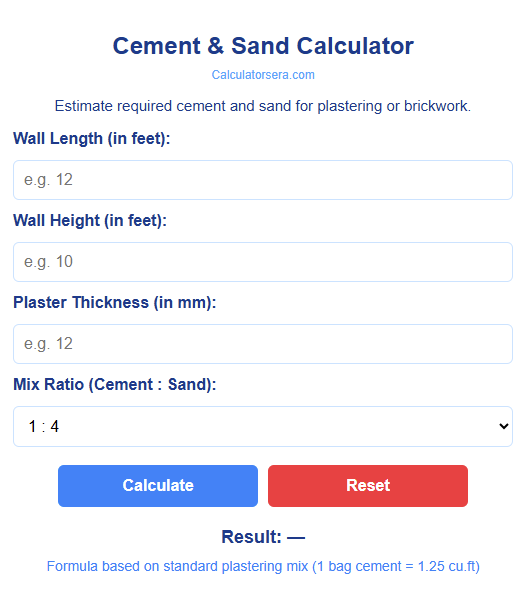
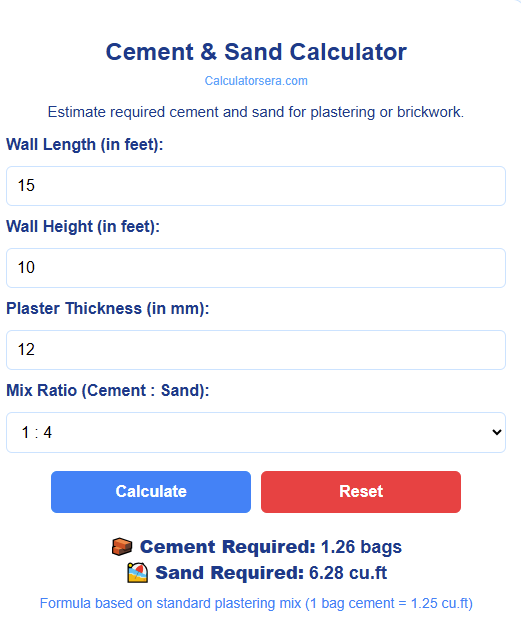
Estimate required cement and sand for plastering or brickwork.
Formula based on standard plastering mix (1 bag cement = 1.25 cu.ft)
Introduction
Cement & Sand Calculator Ever stared at a bag of cement and a pile of sand, scratching your head and wondering, “Is this enough?”
Maybe you’re building a small garden wall, plastering your bedroom, or just helping your kid with a school project. Whatever the job, figuring out how much cement and sand you need can feel like a tricky math test. Buy too little, and your project grinds to a halt with a mid-day trip to the hardware store. Buy too much, and you’re left with hardened bags of cement and a pile of wasted sand and money.
What if you had a magic helper that did all the hard math for you?
Well, you do! It’s called a Cement & Sand Calculator. This handy online tool is like a friendly construction expert in your pocket. It helps builders, homeowners, students, and DIY enthusiasts quickly and accurately figure out the exact amounts of materials they need. No more guesswork, no more waste—just smart, efficient planning for a perfect finish every time.
Table of Contents
What Is a Cement & Sand Calculator?
Let’s keep it super simple. A Cement & Sand Calculator is a free online tool that tells you exactly how much cement (in bags) and sand (in cubic feet or meters) you need for any construction job.
Cement & Sand Calculator Think of it like a recipe. When you bake a cake, the recipe tells you you need 2 cups of flour and 1 cup of sugar. A cement calculator does the same thing for building! You tell it what you’re “baking” (a wall, a floor, plaster), how big it is, and it gives you the perfect “recipe” for cement and sand.
It works for all sorts of projects:
- Plastering: Getting those walls smooth.
- Brickwork: Laying bricks to build a strong wall.
- Concrete Mixing: Pouring a sidewalk or a floor slab.
- Floor Screeding: Creating a level floor surface.
Why Do You Need a Cement & Sand Calculator?
You might think, “I can just guess,” but here’s why this calculator is your new best friend:
- Stop Wasting Money: Construction materials are expensive. Wasting cement and sand is like throwing cash into a hole and burying it. The calculator ensures you buy only what you need.
- Perfect Budget Planning: Knowing exactly how many bags of cement to buy means you know the exact cost before you even start. No surprise expenses!
- Avoid “Oops, I Ran Out!”: There’s nothing worse than running out of materials halfway through a job. The calculator prevents this headache, so your project flows smoothly from start to finish.
- Get the Strength Right: Using the wrong mix of cement and sand can make your wall weak or your plaster crumbly. The calculator helps you follow the perfect ratio for a strong, long-lasting result.
How Does the Cement & Sand Calculator Work? (A Step-by-Step Guide)
Using the calculator is as easy as 1-2-3! Here’s a walkthrough:
Step 1: Select Your Project Type
First, tell the calculator what you’re doing. Are you plastering? Laying bricks? Making concrete? You’ll choose from options like “Plaster,” “Brickwork,” or “Concrete.”
Step 2: Enter the Size
Next, you need to tell it how big your project is. This is usually the Area (like the square footage of your wall) or the Volume. You’ll see a box to type this number in.
Step 3: Set the Thickness & Mix Ratio
This is the secret sauce!
- Thickness: How thick is the layer? For plaster, this might be 12 mm (about half an inch). For a concrete slab, it could be 100 mm (4 inches).
- Mix Ratio: This is the recipe! A common ratio is 1:4 (1 part cement to 4 parts sand). The calculator often has common ratios ready for you to pick from.
Step 4: Click “Calculate!”
Hit the button and watch the magic happen!
Step 5: Get Your Results
In a flash, the calculator will show you the results. It will say something like: “You need 4 bags of cement and 0.8 cubic meters of sand.” It’s that simple!
Cement and Sand Mix Ratios Explained (Without the Confusion!)
You hear people say “1:4 mix” or “1:6 ratio.” What does that actually mean?
It’s just like a cooking recipe! A 1:4 mix ratio means 1 bucket of cement is mixed with 4 buckets of sand.
The first number is always for cement, and the second is for sand. Simple, right?
Different jobs need different “recipes” for strength and flexibility. Here are some common ones:
- Plastering for Internal Walls (1:4): A richer mix (more cement) for a smooth, strong finish.
- Plastering for External Walls (1:6): A leaner mix (more sand) that is durable against the weather.
- Brickwork (1:5 or 1:6): A balanced mix that’s strong enough to hold bricks together but not too rigid.
- Floor Screed (1:3): A very strong, cement-rich mix to handle people walking on it all day.
- Concrete (1:2:4): This has three parts! It means 1 part cement, 2 parts sand, and 4 parts aggregate (gravel). Aggregate adds extra strength for things like foundations.
The Formula Behind the Calculator (Made Super Simple)
Cement & Sand Calculator Don’t worry, we won’t get too mathy! But it’s cool to know how the calculator thinks. It basically does two things:
- Finds the Total Volume:
Total Mortar Volume = Area × Thickness
If you have a 10 square meter wall and plaster it 12 mm thick, the calculator first figures out the total space the mortar will fill. - Splits the Volume by the Ratio:
For a 1:4 ratio, the total “parts” are 1 (cement) + 4 (sand) = 5 parts.- Cement Volume = (1 / 5) × Total Mortar Volume
- Sand Volume = (4 / 5) × Total Mortar Volume
The calculator then converts the cement volume into the number of 50 kg bags, which is what you actually buy at the store.
Let’s See an Example:
You’re plastering a 10 m² wall with a 12 mm thickness and a 1:4 ratio.
- Total Volume = 10 m² × 0.012 m = 0.12 cubic meters.
- Cement Part = (1/5) × 0.12 = 0.024 cubic meters.
Sand Part = (4/5) × 0.12 = 0.096 cubic meters. - After converting, the calculator might tell you: “You need about 0.7 bags of cement and 0.096 m³ of sand.”
See? The calculator handles all that tricky math for you!
A Handy Chart for Mix Ratios
Cement & Sand Calculator To make things even clearer, here’s a simple chart that shows how the amount of cement changes with different mix ratios for the same volume of mortar. The higher the sand ratio, the less cement you need!
This chart is a visual guide. Your exact results will depend on your project’s size and thickness.
Real-Life Example: Building a Garden Wall
Cement & Sand Calculator Let’s put it all together with a story. Imagine your name is Alex, and you want to build a small brick garden wall.
- The Wall: You measure it. The area is 100 square feet.
- The Mortar: The layer of mortar between the bricks will be about 0.5 inches thick.
- The Recipe: For brickwork, you choose a 1:6 mix ratio.
You pop these numbers into the Cement & Sand Calculator on Calculatorsera.com.
Click… Calculate!
The Result: “For your project, you will need approximately 2 bags of cement and 0.5 cubic meters of sand.”
How useful is that? Now Alex can go to the store, buy exactly two bags of cement and order the right amount of sand, confident that there will be no waste and no mid-project delays. The wall will be strong, the budget will be on track, and Alex will feel like a construction pro!
Cement & Sand Calculator for Different Jobs
Cement & Sand Calculator Our main calculator is a great all-rounder, but sometimes you need a specialist! At Calculatorsera.com, we have a whole family of tools for specific jobs:
- Plastering Calculator: Perfect for getting those interior and exterior walls buttery smooth.
- Brickwork Calculator: Designed specifically to calculate mortar for laying bricks, blocks, or stones.
- Concrete Mix Calculator: Essential for bigger projects like driveways, patios, and foundations. It calculates cement, sand, and aggregate.
- Tile Flooring Calculator: Helps you figure out the mortar needed to lay tiles evenly and securely.
- Masonry Calculator: A versatile tool for various block and stone work.
Benefits of Using the Calculator
Cement & Sand Calculator Let’s quickly recap why you should always use a calculator:
- Saves Time: No more manual calculations or head-scratching.
- Saves Effort: It does the hard work, so you can focus on the building.
- Prevents Waste: Good for your wallet and the planet.
- Guarantees Accuracy: Build with confidence knowing your mixes are correct.
- A Great Learning Tool: Perfect for students and new engineers to understand material estimation.
Quick Reference: Cement & Sand Conversion Table
Cement & Sand Calculator Here’s a simple table to give you a rough idea of how much material is needed per cubic meter of mortar. (Remember, this is a guide—always use the calculator for your specific project!).
| Mix Ratio | Cement (50 kg Bags) | Sand (Cubic Meters) |
|---|---|---|
| 1:3 | ~12 bags | 0.43 m³ |
| 1:4 | ~9 bags | 0.54 m³ |
| 1:5 | ~7.5 bags | 0.60 m³ |
| 1:6 | ~6.5 bags | 0.65 m³ |
You can see clearly that as the sand in the ratio goes up, the number of cement bags needed goes down.
Pro Tips for a Perfect Cement and Sand Mix
Cement & Sand Calculator A great recipe is useless if you don’t mix it well! Here are some tips:
- Use Fresh Cement: Cement absorbs moisture from the air over time. Always use bags that are firm and haven’t been sitting around for months.
- Choose the Right Sand: Use clean, well-graded river sand or construction sand. Avoid sand with dirt, clay, or salt, as it weakens the mix.
- Water is Key: Don’t add too much water! A good mix should be like a thick, workable paste, not a soupy liquid. Too much water makes it weak.
- Mix Thoroughly: Whether you’re using a mixer or a shovel, make sure the color is consistent with no streaks of pure cement or pure sand.
- Follow the Ratio: Stick to the recommended ratio. “A little extra cement” might seem like a good idea, but it can make the mix too brittle and crack.
Be a Planet Hero: An Environmental Tip
Did you know cement production creates a lot of carbon dioxide? By using a calculator to buy only what you need, you are actively reducing waste and helping the environment. Every bag of cement you don’t waste is a small win for the planet. If you have leftover sand, it can often be used for other garden or landscaping projects!
Common Mistakes to Avoid
- Ignoring Wastage: The calculator gives you the exact amount. It’s smart to add an extra 5-10% to account for spills and minor errors.
- Mixing Up Units: Be consistent! If you start with feet, stick with feet. If you start with meters, stick with meters. The calculator usually lets you choose, but don’t mix them.
- Forgetting Thickness: A thicker plaster layer uses much more material. Always double-check your thickness measurement.
- Using the Wrong Ratio: Using a brickwork ratio for plastering will lead to a poor finish. Always select the right ratio for the job.
Frequently Asked Questions (FAQs)
What is a cement & sand calculator?
It’s a free online tool that quickly tells you how many bags of cement and how much sand you need for your construction project, based on the size and type of job.
How do I use it for plastering?
Select “Plastering,” enter your wall area, the plaster thickness (e.g., 12mm), and choose a mix ratio (e.g., 1:4). Click calculate!
What does 1:4 mean in a cement mix?
It’s the recipe! It means 1 part cement is mixed with 4 parts sand. So, for 1 bucket of cement, you’d use 4 buckets of sand.
How many bags of cement do I need for a 100 sq ft wall?
It depends on the thickness and the mix ratio! For a 100 sq ft brick wall with a 0.5″ mortar thickness and a 1:6 ratio, you’d need roughly 2 bags. Always use the calculator for your specific project.
How much sand do I need for 1 bag of cement?
It depends on your ratio! For a 1:4 ratio, you need 4 parts sand for 1 part cement. Since one 50kg bag of cement is roughly 0.035 m³, you’d need 4 x 0.035 = 0.14 m³ of sand.
Can I use it for concrete too?
Absolutely! We have a dedicated Concrete Calculator that also includes aggregate (gravel) in the calculation.
How do I calculate for tiling a floor?
Use our Tile Flooring Calculator. You’ll enter the floor area and the thickness of the adhesive bed to get the material estimates.
Is the calculator on Calculatorsera.com free to use?
Yes! It is completely free to use as many times as you need. No sign-ups, no hidden costs.
Fun Facts About Cement & Sand
- Cement + Water = Heat: The chemical reaction that makes cement harden (called hydration) actually creates heat! This is why large concrete pours can get very warm.
- Ancient Super-Mortar: The Great Wall of China used a special mortar made from sticky rice and lime. It was incredibly strong and is part of why the wall has lasted so long!
- One Bag’s Reach: A single 50 kg bag of cement can make about 0.035 cubic meters of mortar, which is enough to plaster a surprisingly large area.
- Sand’s Important Job: Sand isn’t just filler! It adds strength, reduces shrinking and cracking, and makes the mixture more workable.
Conclusion
So, there you have it! The humble Cement & Sand Calculator is more than just a tool—it’s your partner in planning a successful, stress-free, and cost-effective construction project. It turns a complicated guessing game into a simple, sure-thing.
Whether you’re a professional builder, a weekend DIY warrior, or a student learning the ropes, this calculator saves you time, money, and materials. It empowers you to build things the right way, from the very start.
Ready to start your project?
Before you pick up your shovel, pick up your calculator — because smart planning builds strong walls!
Explore our other handy tools:
- [Internal Link] Concrete Calculator
- [Internal Link] Brick Quantity Calculator
- [Internal Link] Plaster Calculator
External References:
For more on the science of cement, you can read about Cement on Wikipedia. For foundational construction principles, sites like The Constructor offer great civil engineering insights.
Thank you for reading this post, don't forget to subscribe!