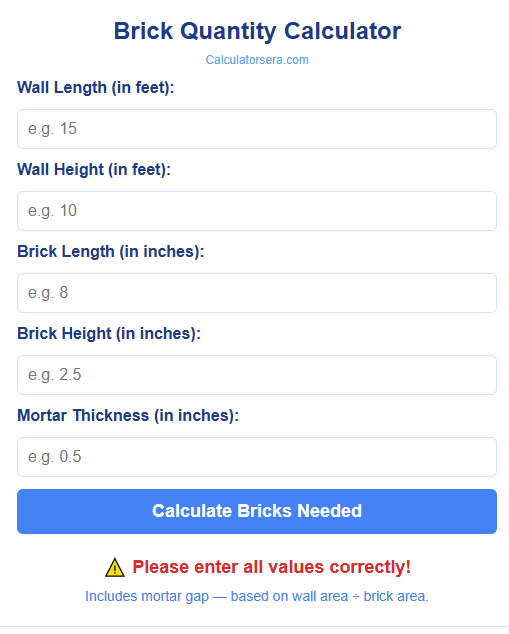
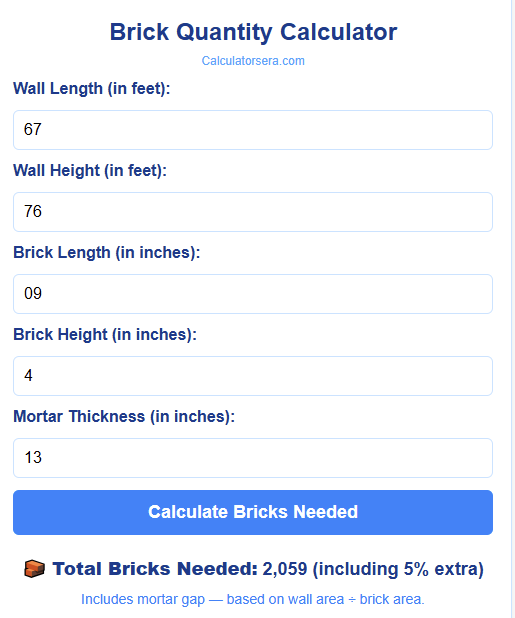
Brick Quantity Calculator
Calculatorsera.com
Includes mortar gap — based on wall area ÷ brick area.
Introduction
Brick Quantity Calculator Ever stared at an empty patch of land and dreamed of building a wall, a garden shed, or even your own house? It’s an exciting thought! But then, a tricky question pops up: “How many bricks will I need?”
Buying too few bricks means pausing your project for another trip to the store. Buying too many means wasting money and having a pile of leftover bricks. Wouldn’t it be great if you could know the exact number, just like that?
Well, now you can! A Brick Quantity Calculator is here to save the day. It’s a super-smart online tool that tells you how many bricks you need for your project in seconds. It saves time, cuts down on waste, and helps you plan your construction like a pro. Let’s dive in and learn how this simple tool can make your building journey smooth and fun!
Table of Contents
What Is a Brick Quantity Calculator?
Imagine you have a magic box. You tell this box how long and how high you want your wall to be. You also tell it the size of your bricks. The box then instantly tells you the exact number of bricks to buy. That’s exactly what a Brick Quantity Calculator is!
It’s a free online tool, like the ones on calculatorsera.com, that does all the hard math for you. You just type in a few simple measurements, and poof! You get a reliable estimate. Builders use it to give accurate quotes, homeowners use it to plan DIY projects, and even students use it to learn about construction planning. It’s your personal assistant for any brick-related project.
Why Do You Need a Brick Calculator?
Brick Quantity Calculator You might think, “I can just guess the number,” but guessing with bricks can lead to big problems. Here’s why using a brick calculator is a brilliant idea:
- Saves Time and Money: No more long, complicated calculations on paper. The calculator gives you an answer in seconds, preventing you from spending money on bricks you don’t need.
- Avoids “Too Many” or “Too Few”: Running out of bricks halfway through building a wall is frustrating. So is having a huge, unused stack at the end. The calculator helps you get the number just right.
- Helps in Budgeting: When you know how many bricks you need, you can easily figure out the total cost. This helps you create a realistic budget for your entire project.
- Gives Accurate Results Instantly: Human calculations can have errors. The calculator uses a perfect formula every time, ensuring you get a precise number.
How Does the Brick Quantity Calculator Work? (Step-by-Step)
Using the Brick Quantity Calculator is as easy as playing a simple video game. You just enter your information, and it does the rest. Here’s how it works:
Step 1: Enter Wall Length
How long do you want your wall to be? Type in the number. You can usually use feet, meters, or inches—whatever is easiest for you!
Step 2: Enter Wall Height
How tall should your wall be? Type in that number next.
Step 3: Enter Brick Dimensions
What is the size of one brick? You’ll enter its length and height.
Step 4: Enter Mortar Thickness (Optional)
This is the cement layer between bricks. If you’re not sure, the calculator often uses a standard thickness for you.
Step 5: Click “Calculate”
This is the magic button! Just click it.
Step 6: Get Total Number of Bricks Required
Brick Quantity Calculator The calculator instantly shows you the total number of bricks needed for your wall.
You can even find out the number of bricks for multiple walls by repeating the process for each one and then adding the totals together.
Brick Calculation Formula (Explained Simply)
For the curious minds who wonder what happens behind the magic, here’s the simple formula the calculator uses. Don’t worry, it’s not scary!
The general formula is:
Number of Bricks = (Wall Area) / (Brick Area + Mortar Gap)
Let’s break that down into plain English:
- Wall Area: This is the total surface you want to cover with bricks. You find it by multiplying the Wall Length by the Wall Height.
- Brick Area: This is the face of one brick. You find it by multiplying the Brick Length by the Brick Height.
- Mortar Gap: This accounts for the space the cement takes up. The calculator adds a little extra to the brick’s size to make room for the mortar.
A Simple Example:
Brick Quantity Calculator If your wall is 10 feet wide and 8 feet tall, the wall area is 80 square feet. If each brick is 8 inches long and 4 inches high, the calculator will figure out that you need around 1,400 bricks, including space for the mortar.
Visualizing Your Brick Needs
The chart below helps you visualize how brick quantity changes with wall size and brick dimensions. It’s a quick way to see the relationship at a glance!
Interactive Brick Calculator
As you can see from the dummy data, as the wall area gets bigger, the number of bricks needed increases in a straight line. A 50 sq. ft wall needs about 700 bricks, while a 200 sq. ft wall needs around 2,800 bricks.
Different Types of Bricks (With Examples)
Brick Quantity Calculator Did you know bricks come in different types? The kind of brick you choose can change the look, strength, and cost of your project. Here are some common ones:
- Common Burnt Clay Bricks: These are the classic red bricks you see everywhere. They are great for building most homes and walls.
- Fly Ash Bricks: These are eco-friendly bricks made from waste. They are very strong and good for the planet.
- Concrete Bricks: Made from solid concrete, these are often used for fences or decorative walls because they can be made in different colors.
- Hollow Bricks: These are lightweight bricks with holes in them. They are excellent for keeping heat out, making your house cooler.
- Engineering Bricks: These are the super-strong superheroes of bricks! They are used in places that need extra strength and water resistance, like basements or drainage channels.
Each brick type has different sizes, so the calculator adjusts automatically when you enter the dimensions.
Standard Brick Sizes (Global Examples)
A brick isn’t the same size everywhere in the world! This is why measuring your bricks is so important. Here are some standard sizes from different regions:
- India: 190 mm × 90 mm × 90 mm
- USA: 194 mm × 92 mm × 57 mm
- UK: 215 mm × 102.5 mm × 65 mm
- Australia: 230 mm × 110 mm × 76 mm
Different regions use different brick sizes, so always measure before calculating. The great thing about the Brick Quantity Calculator is that it can work with any size you enter.
Mortar Thickness and Its Impact
What holds the bricks together? It’s the mortar! Mortar is a mix of cement, sand, and water that acts like a powerful glue. The thickness of this mortar joint affects how many bricks you will need.
- Typical mortar thickness is about 10 mm (or 1 cm).
- More mortar = fewer bricks. Thicker mortar lines mean each brick takes up more space, so you need fewer bricks to cover the wall.
- Less mortar = more bricks. Thinner mortar lines mean you can fit more bricks in the same wall area.
Our calculator lets you adjust the mortar thickness to get the most accurate count possible.
How to Calculate Brick Quantity for Multiple Walls
Building a room or a whole house? You’ll have more than one wall. Figuring out the total bricks is easy!
Step 1: Measure the length and height of each wall separately.
Step 2: Use the Brick Quantity Calculator for each wall to find out how many bricks it needs.
Step 3: Add the totals for all the walls together to get the number for your full project.
Fun Tip: You can even calculate for fences, rooms, or garden walls! Just treat each section as a separate wall.
Wastage and Extra Bricks
Bricks can break during transport or handling. Sometimes, you need to cut a brick to fit in a corner. This is why it’s always smart to buy a few extra bricks.
It is recommended to add 5–10% extra bricks for wastage and cutting.
Example: If your calculation says you need 1,000 bricks, you should buy around 1,050 to 1,100 bricks to stay safe. This small extra cost can save you from big headaches later!
Brick Quantity Example (Real-Life Scenario)
Let’s follow Tim, who wants to build one wall for his new garden shed.
- Wall Size: 15 feet long and 10 feet high.
- Brick Size: 8 inches long and 4 inches high.
- Mortar Thickness: 0.5 inches.
Tim puts these numbers into the Brick Quantity Calculator on calculatorsera.com. In less than a second, the result appears: he needs approximately 1,400 bricks.
Using the Brick Quantity Calculator, Tim found this in seconds without any manual math! He can now go to the store confidently.
Benefits of Using an Online Brick Quantity Calculator
Why should you use an online calculator? The benefits are huge!
- Fast and Free: It’s completely free and gives answers instantly.
- Easy for Everyone: Whether you’re a beginner building your first planter box or a professional builder, it’s simple to use.
- Avoids Errors: It eliminates the risk of mistakes you might make on a calculator or with a pencil.
- Works with Different Units: You can input measurements in feet, meters, or inches—it’s very flexible!
- Perfect for Learning: It’s a fantastic tool for construction students or anyone who wants to understand how to plan a project.
Common Mistakes to Avoid
When calculating bricks, people sometimes make small errors that lead to big problems. Here’s what to watch out for:
- Not Including Mortar Gap: Forgetting the mortar will make you think you need more bricks than you actually do.
- Forgetting Openings: If your wall has a door or a window, you don’t need bricks for that space! Remember to subtract it.
- Mixing Different Brick Sizes: Make sure all your bricks are the same size for the calculation. Don’t mix and match sizes in one calculation.
- Not Adding Extra for Wastage: Always remember to add that 5-10% extra for broken or cut bricks.
Brick Calculation for Openings (Doors & Windows)
Walls aren’t just solid rectangles. They have doors and windows! Here’s how to account for them.
Step 1: Calculate the total wall area (Length x Height).
Step 2: Calculate the area of all doors and windows on that wall (Height x Width for each).
Step 3: Subtract the total door/window area from the total wall area. This gives you the net wall area that needs bricks.
Step 4: Use the formula or calculator with this new net area.
Example:
- Total Wall Area = 120 sq. ft
- Door Area = 20 sq. ft
- Net Area for Bricks = 100 sq. ft
- Brick Count ≈ 1,300 bricks
FAQs (Frequently Asked Questions)
How do I calculate the number of bricks for my wall?
You can use the formula (Wall Area / (Brick Area + Mortar Gap)) or, much easier, use our online Brick Quantity Calculator by entering your wall and brick sizes.
What is the formula for brick calculation?
The basic formula is: Number of Bricks = (Wall Length x Wall Height) / ((Brick Length x Brick Height) + Mortar Gap).
How do I include mortar in the calculation?
Our calculator has a special field for mortar thickness. If you’re calculating manually, you add the mortar thickness to the brick’s length and height before calculating its area.
How many bricks are in 1 cubic meter?
This depends on the brick size. For a standard metric brick (190x90x90mm), there are about 500 bricks per cubic meter, including mortar.
How do I calculate for windows and doors?
First, calculate the total area of the wall. Then, calculate the total area of all windows and doors. Subtract the window/door area from the wall area. Use this new area in your brick calculation.
What is the standard size of a brick?
There is no single “global” standard. It varies by country. Common sizes are 190x90x90mm in India and 194x92x57mm in the USA. Always check your local brick dimensions.
Should I add extra bricks for safety?
Yes! It is always a good idea to add 5% to 10% extra bricks to your final number to account for breakage and cuts.
Can this calculator be used for boundary walls?
Absolutely! The Brick Quantity Calculator works for any type of wall—boundary walls, garden walls, house walls, and more. Just enter the correct length and height.
Fun Facts About Bricks
Bricks are more fascinating than you think!
- Bricks have been used for over 6,000 years! Some of the oldest bricks were found in the Middle East.
- The Great Wall of China was built using over 3 billion bricks and stones!
- Red bricks get their color from iron oxide, which is the same thing that makes rust red.
- Bricks are incredibly strong and can withstand heat up to 1,200°C, which is why they are used in fireplaces and ovens.
Conclusion
Planning a construction project, big or small, is an adventure. Knowing exactly how many bricks you need is the first and most important step. It saves you from stress, wasted trips, and extra costs. A Brick Quantity Calculator is the smart, modern way to plan perfectly.
Before you start your next construction project, plan smart! Use our free Brick Quantity Calculator on calculatorsera.com and know exactly how many bricks you’ll need — quick, simple, and accurate. Happy building
Thank you for reading this post, don't forget to subscribe!