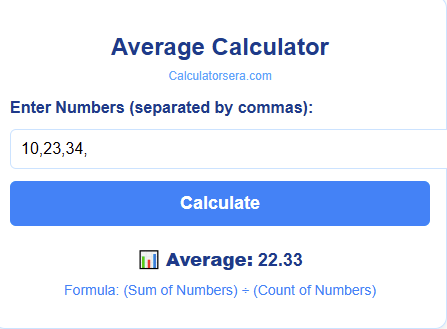
Average Calculator
Calculatorsera.com
Formula: (Sum of Numbers) ÷ (Count of Numbers)
Introduction: The Magic of the Middle Number
Average Calculator Have you ever wondered what your final score is after a few tests? Or how much your family spends on groceries each week? Maybe you’ve wanted to know the average height of your friends. We see averages everywhere! In school, in sports, and even at home.
Finding an average helps us understand what’s “typical.” It finds the middle ground in a bunch of numbers. But let’s be honest, adding up long lists and then dividing can be boring and take a lot of time. What if you could find the average in just one second?
That’s why we made the Average Calculator! It’s a free, super-fast online tool that does all the hard work for you. Just type in your numbers, click a button, and poof—you have your answer. It’s perfect for students, teachers, parents, and anyone who loves saving time.
Table of Contents
What Is an Average? The Story of the “Typical” Value
Average Calculator Imagine you have three chocolates, your friend has five, and another friend has one. If you wanted to share them equally so everyone had the same amount, how many would each person get? You would be finding the average!
In simple words, an average is a single number that represents the “middle” or “central” value of a whole group of numbers. It’s a way to find one number that can stand in for all the others. It tells you what is typical for that group.
Think of it like this:
- If the average score in a cricket match is 75 runs, it means 75 is a typical score for that team.
- If the average price of a toy is $10, it means you can expect to pay around $10 for a toy.
It’s a fantastic way to make sense of a lot of information quickly!
The Simple Formula for Average: The Secret Code
You don’t always need a calculator to find an average. You can do it by hand using a very simple secret code (also known as a formula!). Here it is:
Average = Sum of all numbers ÷ Total count of numbers
Let’s break this down with a fun example. Meet Ali!
Ali scored these marks on his last three math tests: 70, 80, and 90.
Step 1: Find the SUM of all numbers.
This just means add them all together!
70 + 80 + 90 = 240
Step 2: Find the TOTAL COUNT of numbers.
How many numbers did we add? We added three numbers (70, 80, and 90).
So, the total count is 3.
Step 3: Divide the SUM by the COUNT.
240 ÷ 3 = 80
So, Ali’s average math test score is 80! It’s like saying if he scored the same on every test, it would be an 80.
How Does the Average Calculator Work? The Magic Box
Our Average Calculator is like a super-smart magic box. You give it a list of numbers, and it gives you the average in a flash. But it’s not really magic—it’s just very, very fast at doing the steps we just learned!
Here’s what happens inside the tool the moment you click “Calculate”:
- It takes all the numbers you typed in.
- It adds them all together to find the sum.
- It counts how many numbers you entered.
- It divides the sum by the count.
- It shows you the final answer on your screen!
It does all of this in less than a second, and it never makes a mistake in addition or division. How cool is that?
Step-by-Step: How to Use the Online Average Calculator
Average Calculator Using our tool is as easy as playing a simple video game. Just follow these four steps:
Step 1: Enter Your Numbers
Find the big, empty box on the Average Calculator page. This is where you type your numbers.
Step 2: Separate Them with Commas
After each number, put a comma (,) so the tool knows where one number ends and the next begins.
- Example:
10, 20, 30, 40
Step 3: Click “Calculate”
Once your numbers are in, just press the “Calculate” button. You don’t need to do anything else!
Step 4: View Your Average Instantly
Your average will appear right below the button. It’s that quick and easy. Now you can use this number for your homework, your budget, or your project!
Types of Averages: Mean, Median, and Mode
Average Calculator Did you know there is more than one type of “average”? The one we’ve been talking about is the most common one, called the “mean.” But two other important types are median and mode. Let’s meet them!
Mean: The Sharing Average
This is the average we already know and love! It’s the one you get by adding up all numbers and then sharing the total equally.
- Fun Example: Imagine you and your 4 friends have 1, 3, 4, 5, and 7 chocolates.
- Sum = 1+3+4+5+7 = 20 chocolates
- Count = 5 friends
- Mean = 20 ÷ 5 = 4 chocolates per friend.
Median: The Middle-Age Value
Average Calculator The median is the middle number when you line up all the numbers in order from smallest to largest.
- Fun Example: Let’s find the median height (in cm) of five plants: 10 cm, 12 cm, 15 cm, 17 cm, 20 cm.
- First, arrange them in order (they already are!).
- Now, find the number in the very middle. 15 cm is the median height.
Mode: The Most Popular Value
Average Calculator The mode is the number that appears most often, or the most “fashionable” number in the list.
- Fun Example: In a survey, kids said their favorite colors were: Red, Blue, Blue, Green, Red, Blue, Yellow.
- Red appears 2 times.
- Blue appears 3 times.
- Green appears 1 time.
- Yellow appears 1 time.
- Blue is the mode because it appears most often!
For most everyday things, when people say “average,” they are talking about the mean. And that’s exactly what our Average Calculator finds for you!
Real-Life Examples of Averages
Average Calculator Averages aren’t just for math class! They are used all around us every single day.
- Average Marks in Exams: Your teacher might average your test scores to decide your final grade for the term.
- Average Rainfall: Weather scientists find the average rainfall in a month to tell us if it’s a wet or dry season.
- Average Time Spent on Homework: You could track how long you study each day for a week and find the average to plan your schedule better.
- Average Family Expenses: Your parents can calculate the average amount spent on electricity each month to plan the family budget.
- Average Height of Classmates: Your school nurse might find the average height of students in your grade to see how everyone is growing.
Visualizing Averages: A Helpful Chart
Sometimes, seeing a picture can help us understand numbers better. The chart below shows two different sets of numbers and their averages. You can see how the average gives you a central point for the data.
Average Values Visualization
📊 How averages work: Set 2 has larger numbers, so its average (30) is higher than Set 1’s average (20)
Look at the first set of numbers: 10, 20, and 30. The average is 20, right in the middle! The second set has bigger numbers: 15, 25, 35, and 45. This makes the average (30) higher. Charts like this help us see how averages work at a glance.
Benefits of Using an Online Average Calculator
Why should you use our tool? Here are some great reasons:
- Quick and Accurate: Get your answer in less than a second, with perfect accuracy every time.
- Saves Time: No more long addition and division. You save precious time for more important things.
- Great for Everyone: Whether you’re a student doing homework, a teacher preparing lessons, or a professional analyzing data, this tool is for you.
- No Math Mistakes: It never gets tired and never adds wrong. You can always trust the result.
- Works for Any Numbers: You can calculate the average of marks, money, speed, weight, or even your favorite cricket player’s scores!
If you’re working with percentages, like test scores, you might also find our Percentage Calculator super helpful!
Manual Example Calculation: Doing it Step-by-Step
Let’s try one calculation together from start to finish, just to make sure we’ve got it. Let’s find the average of these numbers: 10, 20, 30, 40, 50.
Step 1: Find the Sum.
10 + 20 = 30
30 + 30 = 60
60 + 40 = 100
100 + 50 = 150
So, the sum is 150.
Step 2: Find the Total Count of Numbers.
We have five numbers: 10, 20, 30, 40, 50.
So, the total count is 5.
Step 3: Divide the Sum by the Count.
150 ÷ 5 = 30
The average is 30! It’s simple when you break it down. But for longer lists, our online Average Calculator is the way to go.
Common Mistakes to Avoid
When people calculate averages, sometimes small mistakes can happen. Here’s what to watch out for:
- Forgetting to Count All Numbers: If you have the numbers 5, 10, 15, and 20, remember there are four numbers, not three!
- Mixing Units: Never average numbers with different units without converting them first. For example, don’t mix 100 cm and 1 m. First, convert 1 m to 100 cm, then find the average.
- Typing Errors: When using the calculator, double-check that you’ve typed the numbers correctly. Putting 55 instead of 5.5 will give a very different average!
Fun Facts About Averages
- Did you know? The word “average” has a fun history. It comes from an old shipping term! A long time ago, if a ship lost some goods in a storm, all the merchants who owned cargo on the ship would share the loss “on average.” This sharing of loss was called “havaria,” which later became the word “average.”
- Averages are used to find the batting average in cricket, which tells us how good a batsman is.
- Scientists use averages all the time. For example, they calculate the average temperature of the Earth to track global warming.
Frequently Asked Questions (FAQs)
What is the formula for average?
The formula is: Average = (Sum of all numbers) ÷ (Total count of numbers).
How can I find an average quickly?
The quickest way is to use our Average Calculator! Just enter your numbers and get the result instantly.
What’s the difference between mean and average?
Usually, “average” refers to the “mean.” But technically, “average” can be a general term, while “mean” is the specific type you get from adding and dividing. For everyday use, you can think of them as the same.
Can I enter decimal numbers?
Absolutely! Our calculator can handle decimals like 10.5, 2.75, and 99.9 without any problem.
Can this calculator calculate a weighted average?
This specific tool calculates the simple average (mean). For a weighted average (where some numbers count more than others), you would need a specialized tool like a Weighted Average Calculator.
Is this calculator good for students?
Yes! It’s perfect for students. It helps them check their homework answers, understand the concept of averages, and save time on long calculations.
What if I only have one number?
If you only enter one number, the average will be that same number! For example, the average of [25] is 25.
Where can I learn more about mean, median, and mode?
You can check out our dedicated Mean Median Mode Calculator for a tool that finds all three for any dataset!
Conclusion: You’re an Average Expert!
Now you know all about averages! You know what they are, how to calculate them, and how they are used in real life. They help us simplify big groups of numbers into one easy-to-understand value.
The next time you have a list of numbers—whether it’s your science project data, your weekly allowance, or your basketball scores—remember that our Average Calculator is here to help. It’s fast, free, and fun to use.
So, what are you waiting for? Try it now — and see how smart you are with numbers!
P.S. If you found this tool helpful, explore other cool tools on calculatorsera.com, like our Percentage Calculator and other Statistics Tools!
Thank you for reading this post, don't forget to subscribe!