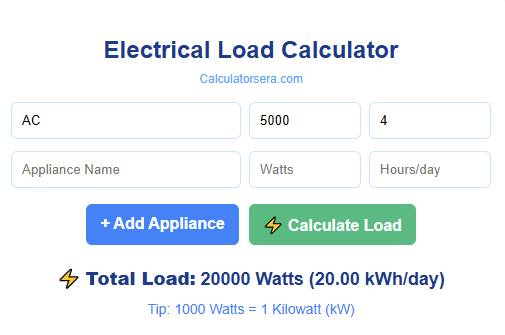
Electrical Load Calculator
Calculatorsera.com
Tip: 1000 Watts = 1 Kilowatt (kW)
Electrical Load Calculator – What It Is & Why It Matters
Electrical Load Calculator Have you ever plugged in too many things at once and heard a scary pop? Or seen your lights flicker when the air conditioner kicks on? That’s your home’s electrical system saying, “I’m working too hard!”
Just like a bridge can only hold so much weight, your home’s wiring can only handle so much power. Understanding this limit is super important. It keeps your family safe. It protects your expensive gadgets. And it can even save you money on your energy bills.
An Electrical Load Calculator is a simple tool that does all the hard work for you. It helps you add up the power needs of everything in your house. This guide will show you exactly how to use it. We’ll explain everything in plain English, with no confusing jargon. Let’s plug in and get started!
Table of Contents
What Is Electrical Load?
Electrical Load Calculator Let’s keep it simple. “Electrical load” is just a fancy term for “how much power your stuff uses.”
Think of it like a water pipe. The water flowing through the pipe is the electricity. The amount of water a sprinkler or a showerhead uses is its “load.” Your appliances are like those sprinklers, each using a different amount of electrical “water.”
To understand load, we need to know three basic friends:

- Volts (V): This is the pressure of the electricity. In the U.S., most homes have 120-volt outlets. Bigger appliances like dryers use 240 volts. It’s like the water pressure in your pipes.
- Amps (A): This is the flow of the electricity. It tells you how much electrical current is moving. It’s like how much water is flowing through the pipe each second.
- Watts (W): This is the total power or work being done. It’s the real measure of your electrical load.
The magic formula that ties them all together is:
Watts = Volts x Amps
So, a 60-watt light bulb on a 120-volt circuit uses 0.5 amps (60 ÷ 120 = 0.5). Easy!
Here’s a table of common appliances and their average wattage to give you an idea:
| Appliance | Average Wattage (W) |
|---|---|
| LED Light Bulb | 10 W |
| Ceiling Fan | 75 W |
| Laptop | 100 W |
| Television | 150 W |
| Refrigerator | 250 W |
| Microwave | 1000 W |
| Hair Dryer | 1500 W |
| Central Air Conditioner | 3500 W |
Why You Need an Electrical Load Calculator
You might be wondering, “Why can’t I just add up the watts myself?” You absolutely can! But an online electrical load calculator makes it faster, easier, and less likely you’ll make a mistake. Here’s why it’s a must-use tool:
- Prevent Overloads and Fires: This is the biggest reason. Overloading a circuit makes wires hot. Hot wires can cause fires. A power load calculator helps you see if you’re asking too much from a single circuit.
- Plan Your Home Wiring Safely: Building an addition? Finishing a basement? You need to know how many outlets and lights a new circuit can handle. Our calculator takes the guesswork out.
- Size a Generator or Inverter: If the power goes out, you need a generator or battery backup. Buy one that’s too small, and it won’t run your fridge. Buy one that’s too big, and you’ve wasted money. An electrical power usage calculator tells you the perfect size.
- Save Money on Bills: When you see which appliances use the most power, you can make smarter choices. Maybe you decide to use that energy-hungry dryer less often.
- Follow the Rules: For any major electrical work, your local building department will want to see a load calculation. Our tool helps you get it right.
The Basic Electrical Load Formula
Before we jump to the calculator, let’s understand the simple math behind it. Knowing the electrical load formula makes you an informed user.
The two most important formulas are:
- Power (Watts) = Voltage (Volts) × Current (Amps)
- Current (Amps) = Power (Watts) ÷ Voltage (Volts)
Let’s see it in action with a real-life example.
Example: You have a 1000-watt microwave. It’s plugged into a standard 120-volt kitchen outlet. How many amps does it use?
Amps = Watts ÷ Volts
Amps = 1000 ÷ 120
Amps = 8.33
So, that microwave uses about 8.33 amps. If your kitchen circuit is a standard 15-amp circuit, the microwave is using more than half of its capacity all by itself!
Example — Calculating Total Load at Home
Electrical Load Calculator Let’s pretend we’re calculating the load for a single room, like a living room. We’ll do it step-by-step.
Step 1: List everything that uses electricity.
Step 2: Find the wattage for each item. (You can usually find this on a label on the appliance or in its manual).
Step 3: Add it all up.
Here’s our living room example:
| Appliance | Quantity | Power (W) | Total (W) |
|---|---|---|---|
| LED Bulbs | 5 | 10 W | 50 W |
| Ceiling Fan | 1 | 75 W | 75 W |
| Television | 1 | 150 W | 150 W |
| Gaming Console | 1 | 200 W | 200 W |
| Total Load | 475 W |
Electrical Load Calculator Great! The total load for this living room is 475 watts.
We often talk about larger power loads in kilowatts (kW). Since 1 kilowatt = 1000 watts, we can convert this.
Total Load (kW) = Total Watts ÷ 1000
475 W ÷ 1000 = 0.475 kW
So, when everything is running, this living room uses 0.475 kilowatts of power.
How the Electrical Load Calculator Works
Our Electrical Load Calculator at Calculatorsera.com automates all that math for you. It’s designed to be super simple.
Here’s how it works:
- Step 1: You enter your appliances. We have a big list of common ones you can just click on.
- Step 2: You tell us how many of each you have.
- Step 3: The calculator uses its built-in database to know the wattage. (You can also type in a custom wattage if you know it).
- Step 4: You press “Calculate.”
In a flash, the tool does this:
- Adds up the total wattage for all your devices.
- Calculates the total amperage for your home’s voltage.
- Shows you the result in both Watts and Kilowatts.
- Lets you play with the numbers. Remove a device and see the load drop instantly!
It’s a powerful way to visualize your home electrical load without any risk or hassle.
Visualizing Load Distribution (Chart Placeholder)
Electrical Load Calculator A list of numbers is okay, but a picture is worth a thousand words. The chart below helps you see exactly how much power each type of appliance is using. It makes it easy to spot the big energy users in your home.
Home Electrical Load Distribution
This chart shows how power is distributed across different appliances in a typical home
In this example chart, you can see the air conditioner is the biggest user of power by far. This is very common!
Different Types of Electrical Loads
Electrical Load Calculator Not all electrical loads are the same. Think about food. Some foods give you quick energy (like sugar). Others give you slow, lasting energy (like protein). Electricity is similar.
Understanding the three main types of loads helps electricians design better and safer systems.
| Load Type | Description | Common Examples |
|---|---|---|
| Resistive Load | The simplest type. It turns electricity directly into heat and light. It uses power in a smooth, steady way. | Incandescent Lights, Toasters, Space Heaters, Electric Ovens |
| Inductive Load | More complex. These have electric motors inside. Motors create a magnetic field, which causes a “surge” when they first start up. | Fans, Air Conditioners, Refrigerators, Washing Machines, Power Drills |
| Capacitive Load | These store electrical energy and release it. They are rarely found in homes as appliances, but are used to correct power issues from inductive loads. | CFL Light Bulbs, TV Circuit Boards, Computer Power Supplies |
Why does this matter? Because that “startup surge” from inductive loads like your fridge or A/C can be two to three times its normal running wattage! A good circuit load calculator will often account for this to give you a truly safe result.
Real-Life Uses of Electrical Load Calculation
Electrical Load Calculator This isn’t just a classroom exercise. People use load calculations every day for important projects.
- Planning Home Circuits: An electrician uses a load calculation to decide how many outlets to put on a single circuit in your new kitchen. This prevents you from tripping a breaker every time you use the toaster and microwave together.
- Office Electrical Design: A business owner needs to make sure their office can handle 20 computers, 5 printers, a coffee maker, and the air conditioning all at once without shutting down.
- Generator or Inverter Sizing: You’re buying a generator for storm season. You calculate your essential load (fridge, freezer, a few lights, well pump) to be 2500 watts. Now you know you need a generator that can handle at least 3000-3500 watts to cover the startup surges.
- Solar Panel Load Planning: Going solar? The first step is to know your total energy load. This tells the installer how many solar panels you need on your roof to power your life.
- Smart Energy Monitoring: You get a smart home device that tracks your power. By understanding your load, you can set it to turn off non-essential devices during expensive peak energy hours.
Common Mistakes to Avoid
Electrical Load Calculator When people start calculating their load, a few common errors can lead to big problems.
- Ignoring Startup Surge: Forgetting that a motor (like in an A/C or fridge) needs a big jolt of power to start. Always factor this in!
- Forgetting Small Devices: That phone charger uses 10 watts. Your Wi-Fi router uses 15 watts. It all adds up. Don’t ignore the “small stuff.”
- Using the Wrong Voltage: Remember, big appliances like electric dryers and ovens often use 240 volts, not 120. Using the wrong voltage in your electrical load formula will give you a very wrong amperage.
- Overloading a Single Circuit: Just because the total house load is fine doesn’t mean one circuit isn’t overwhelmed. Pay attention to which outlets are on which circuit.
- Using Wires That Are Too Thin: Thicker wires can handle more amps. A circuit designed for 15 amps needs thicker wire than one for 10 amps. This is a job for a pro!
Safety Tips for Electrical Load Management
Electrical Load Calculator Safety first, always! Here are the golden rules for managing your home electrical load.
- The 80% Rule: A great safety practice is to never load a circuit to more than 80% of its capacity. For a 15-amp circuit, that’s 12 amps. For a 20-amp circuit, that’s 16 amps.
- Use the Correct Wire Gauge: Let a licensed electrician handle this. They know the National Electrical Code rules for which wire thickness to use for each amperage.
- Install Circuit Breakers: Breakers are your first line of defense. If a circuit draws too much power, the breaker trips and shuts it off, preventing a fire. Never replace a breaker with a larger one without a professional inspection.
- Avoid “Daisy-Chaining” Power Strips: Plugging one power strip into another is a major fire hazard. It’s very easy to overload the first outlet.
- Hire a Certified Electrician: For any new wiring, panel upgrades, or if you’re constantly tripping breakers, call a professional. It’s the safest and smartest investment you can make.
Frequently Asked Questions (FAQs)
What does “electrical load” mean in simple terms?
It simply means the total amount of power being used by all your lights, appliances, and devices at any given time.
What happens if the electrical load is too high?
If the load is just a little too high, a circuit breaker will trip to shut off the power. This is a safety feature. If the breaker fails, the wires can overheat and potentially cause an electrical fire.
Can this calculator help me plan for solar panels?
Absolutely! Knowing your total home electrical load is the very first step in figuring out how many solar panels you need to run your home.
Is the electrical load calculator accurate for all my devices?
It is highly accurate as long as you input correct and realistic wattage values. For the best results, check the nameplate on your appliances for their exact wattage rating.
How often should I calculate my home’s electrical load?
It’s a good idea to do a new calculation whenever you add a new major appliance (like a hot tub or a new A/C unit) or if you are planning a renovation.
Conclusion
Understanding and calculating your electrical load isn’t just for electricians. It’s a basic part of being a smart and safe homeowner. It helps you prevent dangerous situations, save money on your bills, and plan for your future energy needs, like generators or solar power.
Our Electrical Load Calculator is designed to make this process easy, fast, and accurate for everyone. You don’t need to be a math whiz. You just need a few minutes and a list of your appliances.
Take control of your home’s power today. Try our free Electrical Load Calculator now at Calculatorsera.com and discover how easy smart power planning can be! ⚡
Thank you for reading this post, don't forget to subscribe!