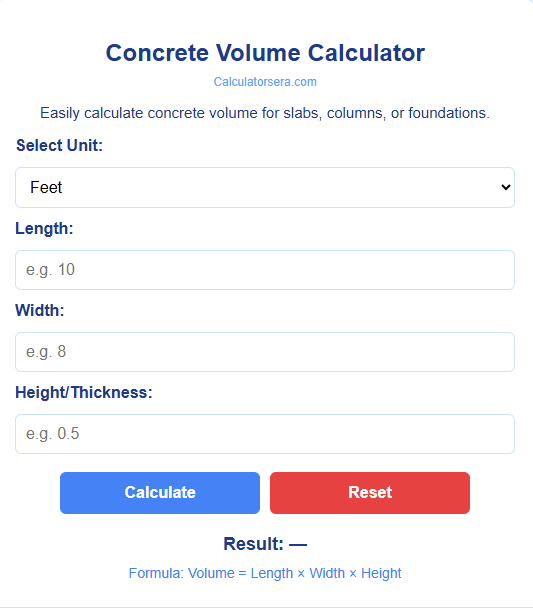
Concrete Volume Calculator
Calculatorsera.com
Easily calculate concrete volume for slabs, columns, or foundations.
Formula: Volume = Length × Width × Height
Ever wondered how much concrete you’ll need to build your floor, pillar, or wall? You’re not alone! Guessing can lead to a big mess. Order too much, and you waste money. Order too little, and your project grinds to a halt.
What if you had a magic helper that did all the tricky math for you? Well, you do! It’s called a Concrete Volume Calculator.
This blog post will be your best friend for any concrete project. We’ll explain everything in simple, easy-to-understand language. No confusing jargon, we promise! Let’s dive in and learn how to build smarter, not harder.
What Is a Concrete Volume Calculator?
Imagine you’re baking a cake. You need to know exactly how much flour, sugar, and eggs to use. Too much or too little, and the cake won’t turn out right. Building with concrete is very similar!
A Concrete Volume Calculator is like a recipe helper for your construction project. It’s an online tool that helps you calculate how much concrete you need for any structure.
You simply tell the calculator the shape and size of what you’re building. For example, a rectangular slab for a floor. You type in the length, width, and depth. The calculator instantly does the math and tells you the total volume of concrete required.
It’s that simple. No more head-scratching or complicated equations. This tool is a lifesaver for DIY enthusiasts, homeowners, builders, and even students learning the ropes.
Table of Contents
Why Do You Need a Concrete Volume Calculator?
You might think, “I can just do the math myself.” And you could! But this calculator makes everything faster, cheaper, and easier. Here’s why you need one:
- Prevents Material Shortage or Wastage: This is the biggest reason. Concrete sets quickly. If you run out halfway through pouring a slab, you’ll have a weak spot. On the other hand, leftover concrete is just a hardened, expensive lump you have to get rid of. The calculator gives you the perfect amount.
- Helps in Budgeting: Concrete is made from cement, sand, and gravel (called aggregate). By knowing the total volume, you can accurately calculate how many bags of cement and how much sand and gravel you need to buy. This stops unexpected costs from popping up.
- Saves Time on Manual Calculations: Manual math takes time and is prone to errors. One small mistake can throw off your entire project. The calculator gives you an answer in seconds, so you can focus on the actual building.
- Useful for Everyone: Whether you’re a professional engineer designing a skyscraper, a contractor building a house, or a homeowner making a new garden path, this tool is for you.

How Does the Concrete Volume Calculator Work? (Step-by-Step)
Using our Concrete Volume Calculator on Calculatorsera.com is as easy as 1-2-3. Here’s a simple walkthrough:
Step 1: Choose the Shape
First, you tell the calculator what you are building. Is it a flat slab? A tall column? A deep foundation? Our tool lets you pick from common shapes like:
- Slab (for floors, driveways)
- Column or Pillar (vertical supports)
- Beam (horizontal supports)
- Footing (the base of a structure)
- Cylinder (for tanks, pipes)
Step 2: Add Your Dimensions
Next, you’ll type in the measurements. This is usually the length, width, and height (or thickness). The tool will ask for the specific measurements needed for your chosen shape. Make sure you use the same unit for all, like all in feet or all in meters.
Step 3: Click Calculate
This is the easiest part! Just hit the “Calculate” button.
Step 4: Get Your Concrete Volume
Like magic, the calculator will show you the total concrete volume you need. It will usually be in cubic meters (m³) or cubic feet (ft³).
Step 5: See Material Breakdown (Bonus!)
Many advanced calculators, including ours, go a step further. They can also show you the estimated amount of cement, sand, and aggregate needed based on the concrete mix ratio you plan to use.
Concrete Volume Formula (Explained Simply)
How does the calculator do it? It uses simple math formulas that you probably already know! The most common one is for a rectangular shape:
Volume = Length × Width × Height
It’s just like finding how many little cubes can fit inside a big box.
Let’s look at an example:
You want to build a small concrete slab for a garden shed. The slab will be:
- Length: 10 feet
- Width: 8 feet
- Height (Thickness): 0.5 feet (or 6 inches)
Now, let’s plug it into the formula:
Volume = 10 ft × 8 ft × 0.5 ft = 40 cubic feet
So, you would need 40 cubic feet of concrete for this slab. See? It’s not so scary.
For other shapes, like cylinders or pyramids, the calculator uses different (but just as simple) geometric formulas so you don’t have to.
Visualizing Your Concrete Mix
Let’s look at what goes into a standard concrete mix. This chart shows you the typical composition for a common 1:2:4 ratio.
This chart shows how cement, sand, and gravel mix together in a standard concrete ratio. As you can see, gravel makes up most of the volume, held together by the cement and sand paste.
Common Concrete Mix Ratios (Explained Simply)
You’ll hear builders talk about “mix ratios.” This just means the recipe for making concrete. It tells you the proportion of Cement, Sand, and Gravel (Aggregate) to use.
Let’s use a fun analogy. Imagine you’re making a giant jug of juice.
- Cement is the strong, concentrated juice mix.
- Sand is the water that dissolves the mix.
- Gravel is the chopped fruit you add for bulk and texture.
The ratio is always written as Cement : Sand : Aggregate.
Here are the most common ones:
- 1:3:6 (M10) – Light Concrete: Good for non-structural work like filling trenches or making a base under a main slab. It uses less “juice mix” (cement), so it’s weaker but cheaper.
- 1:2:4 (M15) – Normal Concrete: This is the all-rounder. It’s perfect for most home projects like floors, paths, and foundations. It has a balanced strength and cost.
- 1:1.5:3 (M20) – Strong Concrete: Use this for important structural work that needs to be extra strong, like supporting beams, columns, or heavy-duty driveways. It has more “juice mix” (cement), making it stronger.
Example Calculation for Real-Life Projects
Let’s make this real with some examples you might try at home.
Example 1: A Small Backyard Floor (using 1:2:4 mix)
You’re building a 12 ft x 10 ft floor for a new shed, with a thickness of 0.5 ft (6 inches).
- Volume = 12 ft × 10 ft × 0.5 ft = 60 cubic feet.
- Let’s convert to cubic meters for materials: 60 ft³ ≈ 1.7 cubic meters (m³).
Now, let’s figure out how much cement, sand, and gravel we need for a 1:2:4 mix.
- Total Parts = 1 (cement) + 2 (sand) + 4 (gravel) = 7 parts.
- Cement Needed = (1.7 m³ × 1) / 7 = 0.24 m³.
Since 1 bag of cement is about 0.035 m³, you would need 0.24 / 0.035 ≈ 7 bags of cement. - Sand Needed = (1.7 m³ × 2) / 7 = 0.49 m³.
- Gravel Needed = (1.7 m³ × 4) / 7 = 0.97 m³.
Example 2: A Concrete Garden Path
Your path is 20 feet long, 3 feet wide, and 0.25 feet (3 inches) thick.
- Volume = 20 ft × 3 ft × 0.25 ft = 15 cubic feet.
See how easy it is? You can now confidently buy your materials.
Benefits of Using a Concrete Volume Calculator
We’ve touched on this, but let’s recap the awesome benefits:
- Saves Time and Avoids Manual Math: Get your answer in seconds.
- Prevents Material Wastage: No more throwing away money on leftover concrete.
- Improves Cost Estimation: Know exactly what you’re spending before you go to the store.
- Works for Multiple Shapes: From simple slabs to complex cylinders, it can handle it all.
- Great for Students: A fantastic learning tool to understand volume and construction basics.
Types of Concrete Shapes You Can Calculate
Our Concrete Volume Calculator on Calculatorsera.com is versatile! You can calculate the volume for all these common shapes:
- Slabs: Perfect for floors, driveways, roofs, and patios.
- Columns: For vertical supports like pillars.
- Beams: For horizontal supports over doors or windows.
- Footings: The foundational base that distributes the weight of a house or wall.
- Cylinders: For building round columns, septic tanks, or pipes.
Concrete Strength and Mix Ratio Table
Concrete is graded by its strength. A higher number means stronger concrete. Here’s a quick reference table:
| Grade | Mix Ratio (Cement:Sand:Aggregate) | Strength (MPa) | Best For |
|---|---|---|---|
| M10 | 1 : 3 : 6 | 10 | Low-strength bases, blinding |
| M15 | 1 : 2 : 4 | 15 | Floors, paths, foundations |
| M20 | 1 : 1.5 : 3 | 20 | Structural beams, columns |
| M25 | 1 : 1 : 2 | 25 | Heavy-duty structures, bridges |
Understanding Concrete Units
This is where many people get confused. Let’s clear it up!
- 1 cubic meter (m³) = 35.3 cubic feet (ft³)
- 1 bag of cement = 50 kg ≈ 0.035 cubic meters (m³)
Why does this matter? When you use the calculator, you must be consistent. If you enter length and width in feet, your height must also be in feet. The calculator will give you an answer in cubic feet. If you need it in cubic meters, you can convert it.
How to Estimate Cement, Sand, and Aggregate from Volume
We did a small example earlier. Let’s look at the general formula. If you’re using a 1:2:4 ratio:
- Total Parts = 1 + 2 + 4 = 7
- Cement Quantity = (Total Concrete Volume × 1) / 7
- Sand Quantity = (Total Concrete Volume × 2) / 7
- Aggregate Quantity = (Total Concrete Volume × 4) / 7
Remember to convert the final cement volume into bags (1 bag = 0.035 m³).
Tips for Perfect Concrete Mixing
Knowing the volume is half the battle. Mixing it well is the other half!
- Use Clean Water: Dirty water can weaken the concrete.
- Avoid Too Much Water: A soupy, watery mix is weak. The concrete should be thick but workable.
- Mix Thoroughly: Make sure the color is uniform, with no dry patches of sand or cement.
- Use Fresh Cement: Old cement that has been stored for months loses its strength. Check the manufacturing date.
- Cure the Concrete: After pouring, keep the concrete moist for at least 7 days. This helps it become strong and crack-free. You can spray it with water and cover it with plastic.
Common Mistakes to Avoid
- Wrong Unit Conversion: Mixing meters and feet is the #1 error. Double-check your units!
- Ignoring Shape Type: Calculating a column as a slab will give you a very wrong answer.
- Forgetting Thickness: A slab’s thickness is its “height.” Don’t forget to include it.
- Skipping the Waste Factor: It’s smart to add a 5-10% extra to your total volume to account for spills and uneven ground.
- Not Adjusting for Moisture: Wet sand already contains water. If your sand is damp, you may need to slightly adjust the amount of water you add to the mix.
FAQs (Frequently Asked Questions)
What is a concrete volume calculator?
It’s a free online tool that calculates the amount of concrete needed for a project based on its shape and size.
How do I calculate for a slab or column?
For a slab, use Length x Width x Height. For a square column, it’s the same. For a round column, the calculator uses a special formula (πr²h).
What’s the best concrete mix ratio for a house floor?
1:2:4 (M15) ratio is perfect for most house floors and foundations.
How many bags of cement are in 1 m³ of concrete?
It depends on the mix ratio. For a 1:2:4 mix, it’s roughly 7-8 bags per cubic meter.
Can I use this calculator for a road or foundation?
Absolutely! The calculator works for any project where you need to know the volume of a shape. For foundations, you would use the “Footing” or “Slab” shape.
What’s the difference between M20 and M25 concrete?
M25 concrete is stronger than M20. M20 is used for beams and columns in houses, while M25 is used for heavier structures like bridges and high-rise buildings.
How much water should I use in my concrete mix?
A good rule of thumb is to use about half the weight of the cement. So, for one 50kg bag of cement, use about 25 liters of water. But always start with less—you can always add more to get the right consistency.
Is the calculator on Calculatorsera.com free to use?
Yes! Our Concrete Volume Calculator is completely free, with no sign-up required. We want to help you build your dreams without any hassle.
Fun Facts About Concrete
- Concrete is the second-most-used substance on Earth, after water!
- The Pantheon in Rome has a massive concrete dome that is over 2,000 years old and still standing. That’s some strong concrete!
- Concrete actually gets stronger over time as it continues to cure, for years and even decades.
- There is such a thing as floating concrete! It’s called lightweight concrete and is used to build boats and floating platforms.
Conclusion
So, there you have it! You’re now a concrete volume expert. No more guessing, no more wasting money on extra bags of cement, and no more worrying about your project running out of mix.
A Concrete Volume Calculator is your secret weapon for a successful and stress-free building project. It brings accuracy, speed, and confidence to your work, whether you’re a pro or a weekend DIYer.
Next time you mix concrete, use our Concrete Volume Calculator on Calculatorsera.com — and build smarter, not harder!
Thank you for reading this post, don't forget to subscribe!