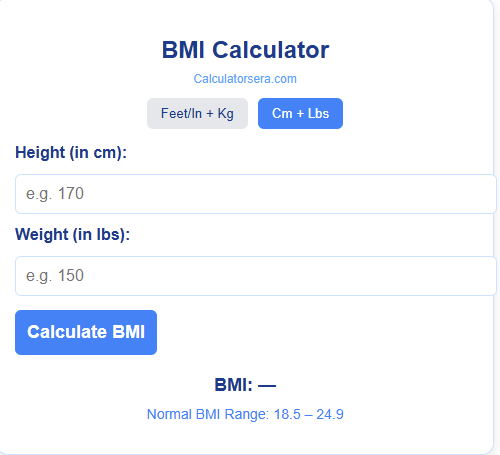
BMI Calculator
Calculatorsera.com
Normal BMI Range: 18.5 – 24.9
BMI Calculator: Your Simple Guide to a Healthier You
Ever wondered if your weight is healthy for your height? It’s a question many of us think about. But who wants to do complicated math? Not us! That’s where a BMI Calculator comes in. It’s a super simple tool that gives you a number to help you understand your body better. Think of it as a quick check-up, like a speedometer for your car, but for your body’s weight.
This guide will walk you through everything you need to know about the Body Mass Index Calculator. We’ll explain it in the simplest words, just like a teacher would. No scary medical terms, we promise! By the end, you’ll be a BMI expert, ready to use our free online BMI calculator with confidence.
Table of Contents
What Is BMI (Body Mass Index)?
BMI Calculator Let’s start with the basics. BMI stands for Body Mass Index. It’s a simple number that helps you see if your weight is in a healthy range for your height.
Imagine you have two friends who both weigh 70 kilograms (about 154 pounds). One friend is very tall, and the other is much shorter. The taller friend might look very thin, while the shorter friend might look heavier. That’s because height matters! BMI combines your height and weight into one special number. This number helps give a clearer picture of whether your weight is healthy for your specific height.
So, if your BMI is 22, that generally means you have a healthy balance between how tall you are and how much you weigh. It’s like a quick snapshot of your body’s composition.
What Is a BMI Calculator?
A BMI Calculator is a tool that does all the math for you. You don’t need a pen, paper, or a calculator. You just type in two things: your height and your weight. In seconds, it tells you your BMI number and what that number means.
It’s used by millions of people all over the world, from doctors and nurses to teachers and fitness trainers. It’s a popular first step for anyone starting their health and fitness journey because it’s so easy and fast.
How Does the BMI Calculator Work?
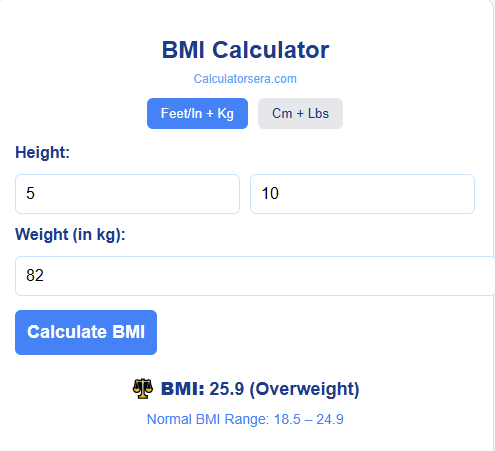
Using our BMI Calculator is as easy as 1-2-3-4! Here’s a step-by-step guide:
Step 1: Enter Your Height
You can type in your height in feet and inches, or in centimeters. Just pick the system you’re most comfortable with.
Step 2: Enter Your Weight
Next, you’ll enter your weight. You can use pounds or kilograms. Make sure you use the most recent weight you know.
Step 3: Click “Calculate”
This is the easiest part! Just click the “Calculate” button. Our smart tool will do all the hard work in the blink of an eye.
Step 4: View Your BMI and Category
You’ll see your BMI number pop up. Right next to it, you’ll see a category like “Underweight,” “Normal weight,” “Overweight,” or “Obese.” This category helps you understand what your number means for your health.
The BMI Formula (A Simple Explanation)
BMI Calculator You don’t need to know the formula to use the calculator, but it’s interesting to see how it works! The BMI formula is the same all over the world. Here it is, explained in simple words.
- For the Metric System (using kilograms and meters):
Your BMI equals your weight in kilograms divided by your height in meters squared.BMI = weight (kg) ÷ height (m²) - For the Imperial System (using pounds and inches):
Your BMI equals your weight in pounds, divided by your height in inches squared, and then multiplied by 703.BMI = (weight (lbs) ÷ height (in²)) × 703
It looks a bit tricky, right? That’s exactly why we have a BMI Calculator—so you don’t have to worry about any of this!
A Small Example:
Let’s say John weighs 70 kg and is 1.75 meters tall.
First, find height squared: 1.75 x 1.75 = 3.0625
Then, divide weight by that number: 70 ÷ 3.0625 = 22.86
John’s BMI is about 22.9, which is in the normal weight category.
Visualizing Your BMI: The Category Chart
Once you have your number, you need to know what it means. The chart below shows the different BMI categories. It’s a great way to see where your result fits.
This chart helps you visualize BMI categories such as underweight, healthy, overweight, and obese. As you can see, each category has its own range of numbers.
BMI Categories Explained (With Simple Values)
Now, let’s break down each category in the BMI chart. We’ll use simple, everyday language.
Underweight (BMI less than 18.5)
If your BMI is below 18.5, you are in the underweight category. This means your weight is low for your height. Sometimes, this can be because of a fast metabolism or not eating enough nutritious food. Being underweight can mean your body isn’t getting all the energy and nutrients it needs to stay strong and healthy.
Normal Weight (BMI between 18.5 and 24.9)
This is often called the “healthy” or “normal” range. If your BMI is between 18.5 and 24.9, your weight is generally considered healthy for your height. This range is associated with a lower risk of health problems. It’s a great place to be!
Overweight (BMI between 25 and 29.9)
A BMI in this range means you are heavier than what is typically considered healthy for your height. Carrying extra weight can put a little more stress on your bones and muscles and may increase the risk of developing certain health issues over time. The good news? Even a small amount of weight loss can make a big difference!
Obese (BMI of 30 and above)
This category means a person is carrying a high amount of extra body weight. This can put a lot of strain on the body and significantly increase the risk of diseases like heart disease, diabetes, and high blood pressure. If you fall into this category, it’s a very important sign to talk to a doctor about creating a safe and effective plan for better health.
Why Is Knowing Your BMI Important?
So, why should you bother calculating your BMI? Here are a few key reasons:
- It Tracks Your Health Status: Your BMI is a quick snapshot of your body weight status. It helps you see if you’re in a healthy zone or if you might need to make some changes.
- It’s Useful for Everyone: Doctors use it to screen patients. Fitness trainers use it to set goals. And you can use it for yourself to stay informed about your health.
- It Can Indicate Health Risks: A BMI that is too high or too low can be a warning sign. It may indicate a higher risk for certain health conditions. Remember, it’s not a diagnosis, but it’s a great starting point for a conversation with your doctor.
Real-Life Examples of BMI
Let’s make this even clearer with some stories about everyday people.
Example 1: Ali’s Story
Ali is a office worker. He is 5’9” tall (about 175 cm) and weighs 70 kg (about 154 lbs). When he uses the BMI Calculator, it shows his BMI is around 23. This number falls in the “Normal Weight” category. Ali is happy to know his weight is healthy for his height, and his goal is to maintain it by staying active.
Example 2: Sara’s Story
Sara is a teacher. She is 1.6 meters tall (about 5’3″) and weighs 90 kg (about 198 lbs). When she calculates her BMI, it comes out to around 35. This places her in the “Obese” category. For Sara, this was an eye-opener. She decided to talk to her doctor, who helped her start a simple plan to eat healthier and go for walks. She’s using the BMI Calculator to track her progress over time.
The Awesome Benefits of Using an Online BMI Calculator
Why use our tool instead of doing the math yourself? The benefits are huge!
- It’s Fast and Easy: You get your result in seconds. No thinking required!
- It’s Accurate: Our online BMI calculator uses the exact formula, so you don’t have to worry about making a math mistake.
- No Math Needed: Forget the complicated formulas we showed you earlier. Just type and click.
- Helps You Track Goals: If you are trying to gain or lose weight, you can use the calculator every few weeks to see if you’re moving toward your target BMI range.
- Works on Any Device: You can use it on your phone, computer, or tablet anytime, anywhere.
The Limitations of BMI: What It Doesn’t Tell You
It’s important to know that the BMI Calculator is a helpful tool, but it’s not perfect. It doesn’t tell the whole story about your body.
- It Doesn’t Measure Muscle vs. Fat: BMI can’t tell the difference between muscle and fat. Muscle is denser and heavier than fat.
- Athletes Can Have Misleading BMIs: A bodybuilder with lots of muscle might have a high BMI and be placed in the “Overweight” category, even though they have very little body fat and are very healthy.
- It Doesn’t Show Fat Distribution: The calculator doesn’t know where your fat is stored. Health risks can be higher if fat is stored around the belly compared to the hips or thighs.
Did You Know? Athletes often have higher BMIs due to muscle weight! So if you’re very athletic, your BMI might not be the best measure of your health.
BMI and Simple Health Tips for Everyone
No matter what your BMI is, the goal is always to be healthy and feel good. Here are some simple, friendly tips for everyone:
- Eat Balanced Food: Try to eat a colorful mix of fruits, vegetables, whole grains, and proteins. Think of your plate as a rainbow!
- Exercise Regularly: You don’t have to run a marathon. Find something fun! Dancing, swimming, playing a sport, or even a daily 30-minute walk can do wonders.
- Get Enough Sleep: Your body needs rest to recharge. Aim for 8-10 hours of sleep each night.
- Drink Plenty of Water: Water helps your body work properly. Try to drink at least 6-8 glasses a day.
- Avoid Comparing Yourself to Others: Everyone’s body is different. Your journey is your own. Focus on feeling strong and energetic.
A Note on BMI Ranges by Age and Gender
You might be wondering if BMI is the same for kids, adults, and seniors. For adults, the standard BMI chart we showed you applies to both men and women. However, for children and teenagers, BMI is interpreted differently. It takes age and gender into account because their bodies are still growing and changing. For seniors, a slightly higher BMI might sometimes be better. If you are calculating BMI for a child or an older adult, it’s always best to talk to a doctor for the most accurate advice.
Frequently Asked Questions (FAQs)
What is a BMI?
BMI stands for Body Mass Index. It is a number calculated from your height and weight that helps show if your weight is in a healthy range.
How do I calculate BMI?
The easiest way is to use our free BMI Calculator! Just enter your height and weight, and it does the calculation for you instantly.
What is a healthy BMI?
For most adults, a healthy BMI range is between 18.5 and 24.9.
Can BMI be wrong sometimes?
Yes. Because BMI doesn’t distinguish between muscle and fat, it can be less accurate for very muscular people, pregnant women, or the elderly.
Does BMI differ by age?
The standard categories are for adults aged 20 and over. For children and teens, BMI is age and gender-specific.
What is the ideal BMI for men and women?
The “normal” or healthy range (18.5 – 24.9) is the same for both adult men and women.
How often should I check my BMI?
If you are not trying to change your weight, checking it once every few months is fine. If you are on a weight management journey, checking it every 2-4 weeks can help you track progress.
Is BMI the only measure of health?
No, it’s just one of many tools. Other important measures include blood pressure, cholesterol levels, diet, and activity level.
Did You Know? The BMI formula has been used since the 1800s! It was invented by a Belgian scientist named Adolphe Quetelet.
Conclusion: Your First Step Towards Better Health
BMI Calculator Understanding your BMI is a powerful first step toward taking control of your health. It’s a simple number that can teach you a lot about the balance between your height and weight. While it’s not the only thing that matters, it’s a fantastic and easy tool to have in your health toolkit.
We encourage you to try our free, easy-to-use BMI Calculator right here on calculatorsera.com. It’s fast, private, and designed for everyone.
Knowing your BMI is the first step toward a healthier you — check it now with our easy BMI Calculator!
You May Also Find Helpful:
- Body Surface Area (BSA) Calculator – Useful for medical dosage calculations.
- Ideal Weight Calculator – Discover your healthy weight range.
- Calorie Calculator – Find out how many calories you need each day.
For more trusted health information, you can visit reputable sources like World Health Organization (WHO) or WebMD.
Thank you for reading this post, don't forget to subscribe!